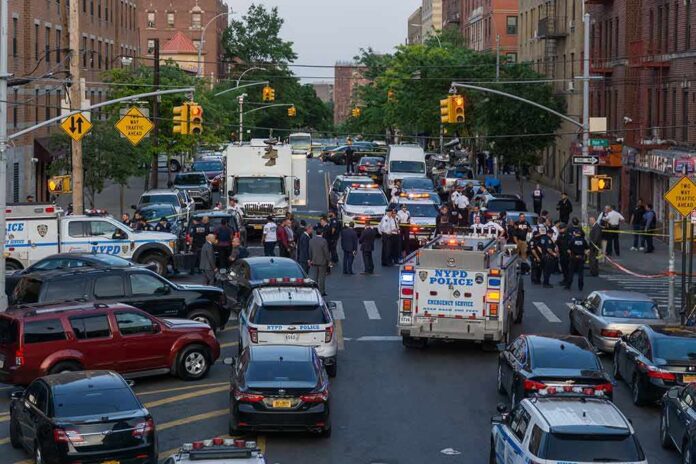
Arrest statistics measure police activity, not crime — and nowhere is that distinction more consequential than on Roosevelt Avenue, the mile-and-a-half Queens corridor where a 59 percent collapse in prostitution-related arrests has become a proxy war over what New York’s approach to street-level vice should look like under a new mayor.
Key Points
- NYPD figures show 193 prostitution-related arrests along Roosevelt Avenue through September 13 of this year, down 59 percent from 468 during the same period in 2025.
- The 2025 total reflected Operation Restore Roosevelt, a multi-agency crackdown launched under Mayor Eric Adams and NYPD Commissioner Jessica Tisch that produced steep, officially documented drops in robbery, felony assault, and burglary along the corridor.
- Mayor Zohran Mamdani’s office has not disputed the arrest numbers; it frames its approach around partnership with local groups, victim services, and “using every tool available to the city”.
- During his 2025 campaign, a Mamdani spokesperson said he would return to a de Blasio-era decriminalization model, ending raids on sex workers while directing district attorneys toward trafficking prosecutions instead.
- A 2021 New York State law repealing the loitering-for-prostitution statute already reshaped how this corridor could be policed, well before either mayor took office.
What the Arrest Numbers Actually Show
The core figures are not seriously contested by anyone quoted in the reporting. NYPD records cited by the New York Post show 193 prostitution-related arrests along Roosevelt Avenue through September 13 of this year, against 468 arrests in the same window in 2025 — a 59 percent decline. Multiple outlets, from wire aggregators to a Chinese-language daily serving Queens’ immigrant communities, repeated the same comparison without disputing its arithmetic. Street-level reporting adds texture to the raw count: one Manhattan man told the Post he could arrange sex for $60 to $80 along the strip, describing the transaction as easier to complete now than at any point in recent memory.
Arrest counts are a blunt instrument, though. They capture enforcement intensity, not underlying prevalence — a police department that stops making proactive vice arrests will show a falling number even if solicitation on the street is unchanged, rising, or merely relocated a few blocks over. That ambiguity is precisely why this dispute has legs: both camps can point to the same 59 percent figure and draw opposite conclusions about what it means.
How Roosevelt Avenue Became the “Market of Sweethearts”
The corridor’s reputation predates any single mayor. Running beneath the elevated 7 train through Jackson Heights, Corona, and Elmhurst, Roosevelt Avenue has functioned as an open-air vice market for decades, with massage parlors and storefronts serving as fronts for brothels. A pivotal legal shift came in February 2021, when New York repealed the state’s loitering-for-the-purpose-of-prostitution statute — the so-called “walking while trans” law — which had given police broad discretion to stop and arrest people based on appearance and location alone. Its repeal removed a tool departments had used, rightly or wrongly, to sweep the corridor, and prostitution networks reportedly grew bolder in operating visibly on the street afterward.
By late 2024, community complaints had grown loud enough that Mayor Adams — then contending with his own federal corruption case — launched Operation Restore Roosevelt, a 90-day, multi-agency campaign combining NYPD enforcement with vacate orders against illegal brothels and outreach to unhoused individuals. City Hall’s own progress report credited the operation with 985 arrests, including 134 for prostitution, alongside more than 11,500 summonses and 18 brothel vacate orders in its first phase. Follow-up enforcement pushed prostitution-related arrests to 468 in the comparable 2025 period and coincided with reported drops in robbery, felony assault, and burglary of roughly a quarter to a third along the strip, according to city officials.
Mamdani’s Stated Rationale: Decriminalization as a Safety Strategy
Mamdani’s position on sex work predates his mayoralty and was never a secret. During the 2025 campaign, spokesperson Dora Pekec said he would “return to the decriminalization approach taken by the de Blasio administration, which means he’ll end raids on sex workers and work with District Attorneys to reduce unnecessary prosecutions”. Critically, that same statement framed the goal not as tolerance for its own sake but as a more effective anti-trafficking strategy: the campaign argued the change would let the city “more effectively combat sex trafficking, reduce exploitation, and keep our communities safe”. City & State reported Mamdani telling reporters his “intended outcome is public safety,” explicitly aligning himself with de Blasio’s prior approach.
Since taking office, City Hall’s messaging on Roosevelt Avenue specifically has stuck to that script rather than engaging the arrest-count debate on its own terms. A mayoral spokesperson told the Post that Mamdani “is committed to partnering with local organizations and neighborhood residents to address conditions on Roosevelt Avenue” and is “using every tool available to the city while treating victims and survivors with the care and dignity they deserve”. Notably, City Hall has not challenged the 59 percent figure itself, nor offered an alternative metric — such as trafficking prosecutions, victim referrals, or displacement data — to argue the underlying problem has actually improved.
The Real Disagreement: Enforcement Versus Diversion
Strip away the partisan framing on both sides and the dispute reduces to a familiar policing question: does arrest-heavy enforcement reduce vice activity, or does it merely disperse it while punishing the most visible and least powerful participants — the workers themselves, disproportionately trafficking victims — rather than the buyers or organizers? Adams-era officials measured success in arrest volume and adjacent crime statistics. Mamdani’s team measures success in something it has not yet quantified publicly: reduced raids, redirected prosecutorial resources toward traffickers, and victim-services engagement. The trouble for that argument, at least for now, is that it rests on stated intent rather than published outcome data — no trafficking-prosecution counts, no victim-services caseload figures have been offered to counterbalance the visible, reported resurgence of street solicitation that residents and reporters describe walking the corridor today.
That asymmetry — hard arrest numbers on one side, policy rationale without matching metrics on the other — is why this story resists a tidy resolution. The 59 percent drop is real and undisputed. Whether it represents a deliberate, defensible reallocation of enforcement priorities or a policy failure showing up on the sidewalk is a judgment call the available evidence does not yet settle definitively, though the burden of proof, absent competing data from City Hall, currently sits with the administration.
The open-air sex trade along Roosevelt Avenue in Queens, widely known as the "Market of Sweethearts", has experienced a dramatic surge in street-level activity even as NYPD enforcement data reveals a sharp decline in arrests.
Residents, local business owners, and community… pic.twitter.com/dmojjUFrDf
— Satguy 141 (@satguy01) September 27, 2026
What Comes Next
Roosevelt Avenue has cycled through crackdown and drift before, and it will likely do so again; the corridor’s economics — cheap storefronts, transit access, a transient immigrant population vulnerable to exploitation — make it structurally resistant to any single administration’s approach. The test for Mamdani’s strategy will not be this year’s arrest tally but whether trafficking prosecutions rise, whether victims are meaningfully connected to services, and whether residents report the corridor as safer a year or two from now. Absent that data, the arrest numbers alone will keep doing the talking — and right now they are saying enforcement pulled back sharply while the trade it targeted did not.
Sources:
zerohedge.com, nypost.com, singtaousa.com, ground.news, gothamist.com, hoodline.com
© featurednews.com 2026. All rights reserved.