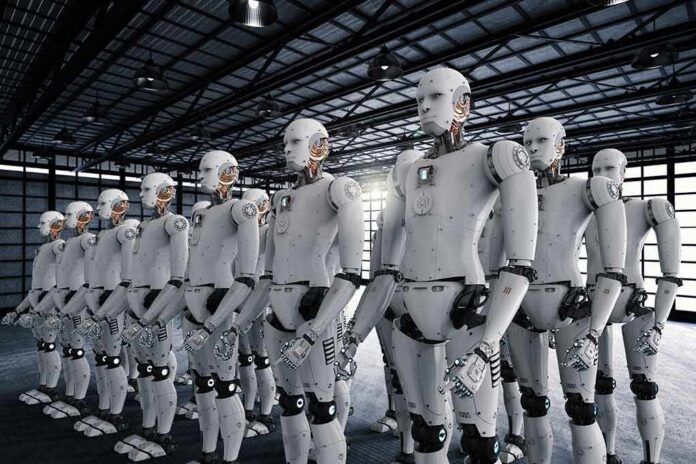
Humanoid robots are not “soldiers” yet; they are tools migrating from factories to frontlines, where—used well—they can take humans out of blast radii, minefields, and kill zones, and—used poorly—they can accelerate escalation and blur accountability. The stakes are not whether these machines show up in war; they already have. The stakes are whether doctrine, engineering, and law keep human judgment in command of force as the machines take on more of the dangerous work.
At a Glance
- Two Phantom MK-1 humanoid robots were shipped to Ukraine for pilot testing in hazardous logistics and reconnaissance tasks, a first-of-kind deployment in a combat theater according to the manufacturer and independent coverage.
- Roughly $24 million in U.S. defense research contracts signal official interest in humanoid ground robots’ military utility, particularly for dangerous, dull, or dirty jobs.
- The near-term reality is human-in-the-loop and human-on-the-loop control, not free-roaming lethal autonomy; the doctrinal center of gravity is combined human-machine operations.
- Powerful ethical and legal critiques remain: autonomy can lower the threshold to violence, erode accountability, and outpace the capacity to distinguish lawful targets—especially in cities.
What has actually been fielded: pilot deployments, not robot infantry
Foundation Future Industries says it sent two Phantom MK-1 humanoid units to Ukraine for a pilot in February 2026, with tasks focused on logistics and reconnaissance in hazardous areas; major business press corroborated that claim with on-record company statements and context from U.S. government backing. The point of a pilot is not to transform a battlefield overnight; it is to see where a platform clears today’s bar—carry loads under fire, climb stairs with gear, open doors, traverse rubble—without exposing a human to the same risk. That is where humanoids fit first: not kicking down doors with rifles, but moving ammunition through mined alleys, hauling stretchers across shell-scarred floors, and scouting collapsed buildings where every pressure plate could detonate. In that slice of the mission set, even incremental reliability is valuable.
Interest is not speculative. Reporting indicates Foundation holds about $24 million in Pentagon research contracts spanning the Army, Navy, and Air Force. Research dollars do not certify a system as war-ready—they buy down risk, prove interfaces, and identify failure modes—but they do signal that the services see enough potential to test in earnest. In the same period, Ukraine’s broader ground-robot adoption has accelerated across wheeled and tracked unmanned ground vehicles for logistics, casualty evacuation, and engineering tasks; the Phantom pilot lands inside that broader experimentation wave, not apart from it.
Why a humanoid form factor, and what that implies for capability
Humanoid platforms are compromises by design. They trade raw efficiency for environmental compatibility: stairs, ladders, hand tools, standardized doors and latches built for human reach and gait. In war’s physical plant—barracks basements, apartment-block stairwells, trench lips cut by shovels—this compatibility matters. A biped can thread narrow passages without widening them, manipulate human tools, and climb obstacles that snag small tracked carriers. The price is complexity. Balancing on rubble with a 25-kilogram load while under concussive shock is nontrivial; getting that to work predictably under jamming, dust, rain, and shrapnel takes hardened actuators, low-latency control loops, and autonomy stacks that degrade gracefully when sensors are blinded. For now, the most robust control model in combat remains teleoperation with assistive autonomy—basically, a human driver with robots handling balance, grasping, and foot placement in the background. That keeps lethal decision-making tightly coupled to human judgment while exploiting the machine’s tolerance for risk.
The ethical and legal fault line: autonomy, not mobility
Critics are not primarily worried about robots that carry rations; they are worried about robots that decide whom to kill. The U.N. Secretary-General has warned that fully autonomous weapons—systems with the discretion to take life without human involvement—could strain or erode existing legal frameworks, and are morally repugnant and politically unacceptable. That view focuses on the decisive boundary: whether a machine may select and engage targets without meaningful human control. Many ethicists and policy groups argue that in complex urban environments, complying with distinction and proportionality is not reliably solvable by current autonomous systems; the risk of misidentification is high, the consequences irreparable. Those concerns speak directly to doctrine: keep humans responsible for the use of force, even as robots assume more locomotion and manipulation.
Escalation risk compounds the dilemma. Analysts caution that faster, more numerous, and less vulnerable systems may lower the threshold to initiate or intensify violence, increase crisis instability, and blur accountability up the chain of command. None of this is abstract in Ukraine’s context; both sides already use autonomous and semi-autonomous air and ground systems. The discipline that tempers those risks—clear rules of engagement, positive human control over weapons release, auditability of decisions—should migrate with the tech. Where autonomy assists navigation, balance, or sensing, it reduces human exposure. Where autonomy starts selecting targets, it invites moral hazard and legal trouble.
Mechanism and limits: what today’s stacks can and cannot do
Modern humanoids typically layer three capabilities. First, mobility autonomy for foot placement, posture, and recovery after perturbation; think of it as a digital vestibular system that keeps the robot upright and moving over uncertain terrain. Second, manipulation autonomy that turns human intent—“open this door,” “lift that crate”—into grasp planning and force control without micromanaging finger torque. Third, mission autonomy that sequences behaviors and fuses perception to propose or execute tasks. In a war zone, the first two are essential and ethically uncontroversial; the third demands guardrails. Lethal autonomy would bolt target recognition and engagement policies onto mission control—a leap most militaries have not authorized for ground robots. The workable compromise is human-on-the-loop teleoperation with autonomy constrained to mobility and manipulation, plus hard interlocks on weapons control. Done right, that architecture reduces operator cognitive load without ceding life-and-death decisions.
Reliability remains the gating factor. Shock, electromagnetic interference, adversarial camouflage, and degraded comms are corrosive to perception and control. A serious program tests failure modes in instrumented ranges, not just choreographed demos. That is what defense research money buys: drop tests for actuators, dust and water ingress trials, timing budgets that survive jamming, and user interfaces a corporal can master under stress. The end state is not a super-soldier; it is a machine assistant that makes fewer unforced errors than a fatigued human in specific, narrow tasks—and is easier to sacrifice if something goes wrong. The battlefield will accept nothing less.
Where the real military value is emerging
Ukraine’s wartime innovation has already validated robots for hazardous logistics: pulling wounded from kill zones under fire, shuttling ammunition across mined fields, probing booby-trapped entryways. Those missions are dull, dirty, and dangerous—the classic “DDD” niche where machines shine. A humanoid’s advantage is access: it can climb the same stairs a medic would, carry the same litter through the same doorway, and use the same handles, valves, and tools. The measurable payoff is reduced human exposure rather than higher lethality. If pilots show that a biped can reliably move 20–30 kilograms through a shelled structure while operators remain behind hard cover, commanders will demand more of them—long before anyone credibly fields autonomous door-kickers.
For force design, the implication is straightforward. Treat humanoids as adjuncts to infantry and engineers: logistics mules that fit human spaces, breaching assistants that hold shields and tools instead of rifles, reconnaissance carriers that put sensors where a head would peek, not as independent shooters. Build doctrine around combined teams and robust comms, not autonomous swarms with ambiguous accountability. This is not aesthetic caution; it is a practical path to value that aligns with law and ethics.
🚨 Foundation Wants to Put Humanoid Robots Into Combat. The CEO Must Define Their Limits Before the Technology Does.
Foundation Future Industries is developing humanoid robots for military use under a $24 million Pentagon contract.
The company’s Phantom MK-1 can carry… pic.twitter.com/zShc3XiW2H
— CEO Branding News (@CEObrandingnews) September 14, 2026
What to watch next: doctrine, not demos
Ignore sizzle reels. Watch requirements documents, safety cases, and rules of engagement. The red flags are unbounded mission autonomy, vague language about “targeting assist,” and weapons integration with no explicit human-release interlocks. The green flags are mundane: mean time between failures under battlefield conditions, operator training hours to proficiency, and after-action data proving reduced human exposure on specific mission types. On the policy front, expect convergence around “meaningful human control” over the use of force, even as ground robots grow more capable; that consensus spans governments, NGOs, and scholars who otherwise disagree about pace and form. The technology will keep improving. The center of gravity should remain where it belongs: humans decide, machines endure the risk.
Sources:
feedpress.me, letsdatascience.com, tandfonline.com, americamagazine.org, plato.stanford.edu, journals.law.harvard.edu
© featurednews.com 2026. All rights reserved.