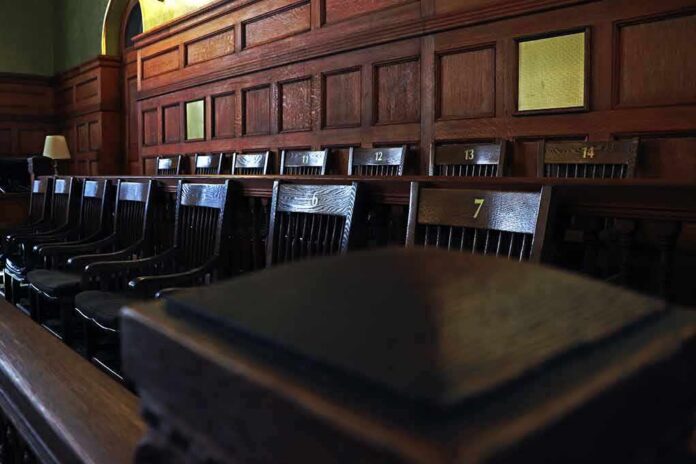
When a jury hangs, the public often hunts for a villain; in American criminal law, dissent by a single juror is not a malfunction but a deliberate safeguard that sometimes collides, uncomfortably, with our appetite for closure.
At a Glance
- A lone holdout can lawfully prevent a unanimous verdict; mistrial is the built‑in remedy, not a legal failure.
- The Lindsay Clancy deadlock was 11–1 toward not guilty by reason of insanity, according to multiple accounts from court and jurors, and ended in a mistrial.
- Removing a deliberating juror is rare and requires evidence of misconduct or inability to follow the law, which the judge did not find here.
- Hung juries recur across criminal courts; they reset the case rather than end it, and retrial is generally permitted.
What a holdout juror is — and what it isn’t
Unanimity in criminal cases gives each juror a veto. That structure is intentional: it forces the state to convince all twelve peers that the law’s burden is met, whether for guilt or for special verdicts like not guilty by reason of insanity. When that unanimity does not materialize, courts do not manufacture a majority-rule outcome; they declare a mistrial. That is not an acquittal or a conviction. It is a legal timeout that sends everyone back to their corners. In the Clancy case, the jury deliberated for days, sent notes indicating an 11–1 split, and the judge, after efforts to spur further deliberation, declared a mistrial because unanimity could not be reached.
The system separates disagreement from misconduct. A juror who simply holds a minority view may frustrate eleven others, but that is not, by itself, grounds for removal. Judges can dismiss a deliberating juror only for concrete reasons unrelated to the merits — illness, outside contact, refusal to deliberate, or explicit defiance of the court’s instructions. Here, despite defense requests, the judge declined to remove the holdout and allowed the impasse to ripen into a mistrial, signaling there was insufficient basis to find misconduct from the bench.
How we got here: the Clancy deadlock, in legal terms
The public record paints the now-familiar outline. Jurors deliberated more than a week, reported an 11–1 division, and the court received notes alleging the lone juror would not apply the definition of reasonable doubt as instructed. Several jurors later told outlets they were prepared to find not guilty by reason of insanity, and that one juror would not join them. Defense counsel sought the juror’s removal and even pursued emergency appellate relief to stop further deliberation with the contested panelist. The trial judge refused to dismiss the juror and, after additional effort to coax continued discussion, declared a mistrial based on deadlock.
Two points matter legally. First, a mistrial for deadlock is a routine, lawful endpoint; it preserves the prosecution’s option to retry because double jeopardy typically does not bar a second trial after a hung jury. Second, juror statements after the fact — about who said what in the room — do not convert a mistrial into a verdict; in American practice, a verdict has legal force only when delivered and affirmed in open court. Post hoc characterizations by participants can be illuminating but are not dispositive law. The trial court’s remedy was the correct one for an honest impasse.
Where disagreement legitimately lives: insanity, standards, and jury conscience
Insanity defenses confront juries with two demanding assessments: the defendant’s mental condition at the time of the act, and the legal threshold that excuses criminal responsibility. Even when jurors broadly accept that mental illness is present, they can disagree — sometimes deeply — about whether the statutory test is met. Reasonable doubt, the law’s highest standard, is precise in text but textured in application; it asks each juror to decide whether the evidence leaves them firmly convinced. In high‑emotion cases, that conscientious line-drawing can look, from the outside, like obstinacy. From the inside, it can feel like duty.
That is why judges are cautious about invading the secrecy of deliberations. American courts protect that space to guard independence and candor, even when the result is untidy. Legal experts consistently warn that removing a juror for the substance of their views risks converting unanimity into coerced conformity — a danger the unanimity rule was designed to prevent.
The pattern: hung juries are a feature of the system, not a glitch
Deadlocked juries surface in a meaningful minority of criminal trials. They are not the norm, but they are not unicorns. The conventional sequence — extended deliberations, clarifying instructions from the judge, then a mistrial if unanimity fails — is the system’s safety valve. Afterward, prosecutors reassess: retry the case, adjust charges, negotiate a plea, or dismiss. Defense lawyers evaluate the record, witness stamina, and public sentiment. Courts schedule, and the process starts anew if the state proceeds. This is why high‑profile cases can replay in the news: a hung jury simply resets the board.
What is unusual in cases like Clancy’s is not the mistrial but the intensity of the backlash. The moment a split becomes public — especially an 11–1 split — the social narrative tends to fixate on the nameless one. That impulse is understandable; it personalizes a complex legal standard. But it also misdiagnoses the mechanism. The holdout is not an extraneous actor; unanimity granted that person formal leverage from day one. The remedy for other jurors who disagree is persuasion within the jury room, not public shaming after the fact.
Accountability without scapegoats
None of this immunizes jurors from scrutiny of actual wrongdoing. Juror misconduct — independent research, undisclosed bias that surfaces in deliberations, refusal to deliberate — can and should trigger judicial intervention, including inquiry and removal. But the trigger must be real evidence, not retrospective frustration recorded in a note or filtered through post‑trial interviews. In the Clancy proceedings, the judge evaluated the record before him and declined removal; the lawful consequence was a mistrial, and the lawful path forward is either a retrial or a negotiated resolution.
The better civic habit, then, is to separate two ideas. We can critique how hard the insanity standard is to apply and whether unanimity ought to be preserved in its current form — those are policy debates worth having. But as long as unanimity governs, a single juror’s dissent is not a breach; it is exactly the bargain the law struck to protect individual judgment in the face of collective pressure. The cost is occasional deadlock. The benefit is a system that values conviction beyond a reasonable doubt as more than a slogan.
Sources:
npr.org, cnn.com, nbcchicago.com
© featurednews.com 2026. All rights reserved.