When a police sidearm discharges in a crowded subway, the physics of a single round become public policy: what fragments, ricochets, and modified duty mean for rider safety, officer training, and how the NYPD investigates itself.
At a Glance
- An NYPD officer’s service weapon accidentally discharged at the Kingston–Throop Avenues station in Bedford–Stuyvesant around 4:40 p.m.
- Bullet fragments struck another officer and a 34-year-old bystander; all were treated and released, and no additional injuries were reported.
- The NYPD’s Force Investigation Division is handling the review; two officers were placed on modified duty during the inquiry.
- Accidental and non-adversarial firearm discharges are a recognized, recurring category in NYPD reporting, not a once-in-a-generation anomaly.
What happened at Kingston–Throop and why it matters
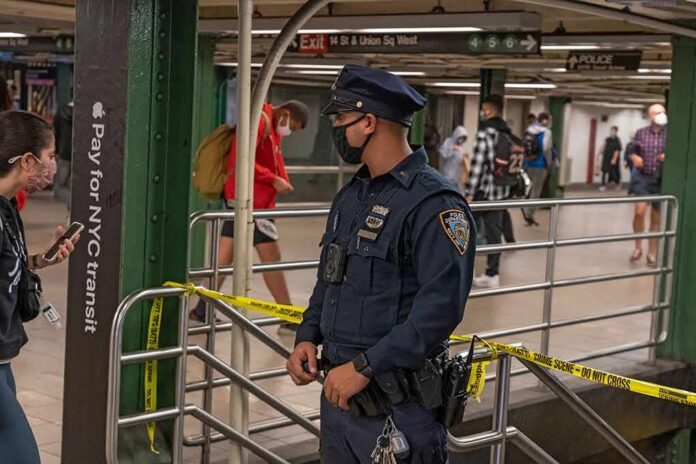
Published accounts agree on the essential sequence: late afternoon inside the Kingston–Throop Avenues station, an NYPD officer’s service weapon fired unintentionally; bullet fragments injured a fellow officer and a 34-year-old woman nearby. Both officers involved and the bystander were transported for evaluation and later discharged with minor injuries. The department stated the discharge was accidental and assigned the matter to its Force Investigation Division, the internal unit responsible for firearms-discharge reviews. For New Yorkers, the stakes are straightforward. The subway is a dense, reverberant environment where a single errant round can create multiple victims. Even when injuries are minor, each accidental discharge is a systems test of training, equipment, tactics, and investigative rigor.
Two details shape the technical picture. First, both injuries were attributed to fragments, consistent with a round that struck a hard surface and spalled, shedding mass into secondary projectiles—a different wounding profile than a direct hit. Second, officials reported no additional casualties and stable conditions for the injured, suggesting low-angle impact into a floor or wall rather than an uncontrolled muzzle sweeping a platform. The distinction matters because fragmentation typically implies a controllable trajectory or a single-point impact; the absence of direct-through wounds aligns with the fragment narrative reported by multiple outlets.
How accidental discharges happen: mechanics and environment
Modern striker-fired duty pistols are engineered to resist firing when dropped; most unintentional discharges trace to human factors (trigger contact under stress, incomplete reholstering, garment or equipment entanglement) or to holster failures. In cramped, high-clutter settings—turnstiles, stairwells, and crowded platforms—the risk factors stack: retention straps, jacket drawstrings, or radio cords can snag a trigger during hurried movements. If a muzzle is down and the impact surface is hard tile or concrete, fragmentation and ricochet are plausible outcomes. Conversely, a muzzle oriented horizontally through a crowd typically produces linear, penetrating trauma inconsistent with fragment-only injuries. The fragment pattern at Kingston–Throop aligns with an impact into infrastructure rather than a direct shot into people, which is why investigators will map impact sites, recover metal, and test the weapon’s function as a first pass.
Environmental acoustics compound risk. Underground structures amplify sound and disorient; a bang can trigger sympathetic responses. Established protocols—verbal control, secure holstering, and separation of weapon handling from other tasks—exist precisely to avoid a cascade. The internal review will ask routine but consequential questions: Was the firearm holstered at discharge? Was any object inside the trigger guard? Did the holster meet retention and trigger-coverage specifications? Was the officer engaged in a simultaneous maneuver that created entanglement risk?
What the NYPD’s review process does—and doesn’t—answer
The Force Investigation Division (FID) conducts administrative and, when indicated, criminal inquiries into discharges. Investigators typically collect and tag projectiles and fragments, canvass for station-camera footage, and pull relevant body-worn camera files if available. They also verify duty status, weapon assignment, and training and qualification dates. Findings feed the department’s use-of-force reporting architecture, which, in recent years, subsumed the historical Annual Firearms Discharge Report into a broader Use of Force framework. The point of that evolution was to standardize categories and illuminate patterns across adversarial shootings, animal shootings, and accidental or negligent discharges.
Those patterns are documented. The NYPD recorded 48 firearm-discharge incidents in 2023, reversing a short uptick and continuing a long-run decline from the high-water eras of the 1970s and early 1980s. RAND’s earlier assessment of NYPD discharges highlighted the meaningful share that were accidental or involved animals, reinforcing that non-adversarial events are a persistent slice of the total, not statistical noise. When an event like Kingston–Throop occurs, it slots into a known taxonomy that guides corrective action: equipment fixes if a holster or pistol feature contributed; training refreshers if handling practices slipped; or discipline if the facts show negligence.
Fragment injuries and forensic reconstruction: what to look for
Fragment wounds tend to be shallow, multiple, and angularly distributed around an impact point. Investigators will try to identify: the primary strike surface; the angle of incidence; and whether fragments are bullet jacket, core lead, or substrate spall (tile, concrete). Each carries different implications. Jacket-heavy fragments with minimal substrate suggest the bullet began breaking apart before or upon impact; substrate-dominant debris implies high-velocity spall from the environment. Trajectory rods, laser mapping, and high-resolution station imagery can connect impact geometry with likely muzzle orientation. Weapon testing under controlled conditions—clearing, safety checks, trigger-weight verification—establishes whether a mechanical failure is plausible. In contemporary service pistols maintained on a standard schedule, true mechanical slam-fires or sear failures are rare; investigators usually locate a proximate human-factor cause.
For the public, two outcome signals matter. Modified duty assignments indicate the department is treating the incident as serious enough to remove or limit street authority during review, a routine but meaningful safeguard. Second, inclusion of the incident in annualized use-of-force statistics makes it part of the city’s shared safety ledger rather than an anecdote—a guardrail against episodic memory shaping policy.
An NYPD officer accidentally fired => her <= service weapon in a Brooklyn subway station Thursday afternoon — and bullet fragments struck another cop and a bystander.
The accidental discharge occured at about 4:40 p.m. inside the Kingston-Throop Avenue station in… pic.twitter.com/T9qelepY6J
— Crime In NYC (@Crime_In_NYC) September 12, 2026
How this compares with other subway gun events
Subway firearms incidents often split into two clusters: adversarial uses of force during arrests or violent encounters, and non-adversarial mishaps like accidental discharges. The injury profile and immediate NYPD characterization place Kingston–Throop firmly in the latter. That distinction isn’t semantic; adversarial shootings trigger a different analytic frame—tactics, threat assessment, backdrop management—while accidental discharges stress firearm-handling fundamentals in confined public spaces. The common denominator is environmental risk: tiled surfaces, tight sightlines, and crowds magnify the consequences of any round fired underground. That is why sustained reductions in total discharges, documented in NYPD reporting, translate directly into fewer subway injuries over time, regardless of category.
What improvement looks like
Best practice in big-city policing couples three levers. First, hardware: holsters that fully shroud the trigger guard, resist entanglement, and guide safe reholstering; sidearm configurations consistent with agency policy on trigger pull and safeties. Second, training: scenario-based repetitions that simulate transit conditions—turnstiles, stair flights, platform edge dynamics—so muscle memory respects environmental constraints. Third, transparency and feedback loops: prompt, factual incident summaries; inclusion in annual reports; and tailored remedial training or equipment changes when an investigation surfaces a pattern. NYPD’s own data infrastructure supports this approach; when it functions well, isolated mishaps become catalysts for system gains rather than recurring headlines.
Sources:
nypost.com, bbc.com, nytimes.com, nyc.gov, policyarchive.org, catalogue.nla.gov.au, jstor.org, theiacp.org
© featurednews.com 2026. All rights reserved.