The rarest failures are the most devastating: a single fatality on a marquee roller coaster can upend public confidence, trigger multi-agency investigations, and force an industry built on engineered thrills to answer hard questions about restraint design, operations, and emergency response.
At a Glance
- Cobb County authorities confirmed one person died and others were injured in an incident involving the Goliath roller coaster at Six Flags Over Georgia.
- Six Flags acknowledged the fatality, expressed condolences, and said it is cooperating with investigators.
- Witnesses reported a rider fell from the train near the end of the ride; evacuations followed and the park paused operations.
- Amusement-ride deaths are uncommon; investigators routinely examine mechanical systems, procedures, and rider behavior to determine cause.
What Happened On Goliath
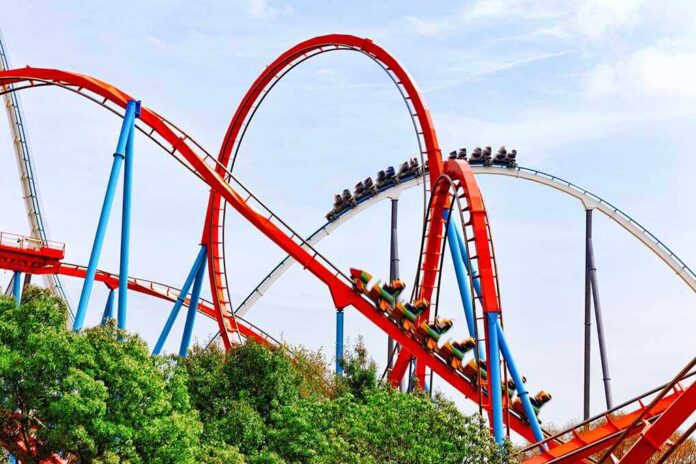
On a busy afternoon at Six Flags Over Georgia, a guest died in an incident involving Goliath, the park’s 200-foot steel “hypercoaster.” Cobb County police and emergency officials confirmed a fatality and additional injuries, and police Major Crimes personnel responded, standard practice when a death occurs in a public setting with uncertain cause. Witness accounts described a rider being ejected and striking structures or the train multiple times, with the immediate aftermath including stalled trains, evacuations down maintenance stairs, and a broad first responder presence. Six Flags issued a statement offering condolences and pledging full cooperation with the investigation while support teams assisted affected guests and employees.
Early witness narratives coalesced around a late-ride event, near the on-ride photo capture point, when the individual appeared out of restraint; these accounts also described blood on riders’ clothing and an urgent shutdown of the attraction. While eyewitness detail varies, the through-line is consistent with what police and the park confirmed: a death on or associated with the coaster, several injuries, and a carefully managed evacuation under law-enforcement supervision.
How Investigations Parse A Rare, High-Consequence Failure
When a catastrophic ride incident occurs, investigators proceed on parallel tracks: mechanical integrity, control systems, and restraint function; operator actions against procedures; and rider position, posture, and behavior relative to design envelopes. Modern hypercoasters employ redundant restraints and interlocks designed to prevent dispatch if a bar is not engaged in a defined range; event logs, programmable logic controller (PLC) records, and sensor histories are typically available to reconstruct the sequence. Interviews with operators and riders, inspection of lap-bar ratchets and hydraulic or pneumatic cylinders, and a review of maintenance records anchor the technical analysis. This disciplined approach is why agencies and parks avoid premature causal claims, even as they confirm the facts of death, injury count, and evacuation.
Because the public rarely sees the underlying data—torque specs on ratchets, clearance envelopes, sensor fault histories—the vacuum is often filled by plausible but conflicting narratives. The sound approach is to separate established public facts from technical inferences: a death occurred, multiple injuries were reported, and the park cooperated with authorities; investigators will determine whether equipment, procedures, or rider factors were determinative.
Risk, Baselines, and Why This Makes Headlines
Fixed-site amusement rides deliver extraordinarily high throughput—millions of cycles annually across the industry—with severe injuries statistically uncommon relative to rides taken. Industry-commissioned analyses with the National Safety Council have long estimated the chance of serious injury on a fixed-site ride at roughly one in tens of millions of rides, a figure professionals use as a baseline for trend monitoring, not a shield against accountability. Historical federal analyses spanning both mobile and fixed-site attractions estimated 71 nonoccupational fatalities across a 15-year period ending in 2002—a small number against total ridership, but each a profound failure of layered safety controls.
This asymmetry—rare events, outsized consequence—is precisely why parks engineer with redundancy, operate with checklists, and drill emergency evacuations. It is also why a single fatality on a flagship coaster dominates the news cycle. The event is extraordinary against the base rate; the reaction and scrutiny are appropriate to the stakes.
What Experts Examine On A Hypercoaster
Restraint systems. Goliath-class coasters typically use contoured seats with individual lap bars that lock via mechanical ratchets or hydraulic systems; many add seatbelts as secondary checks. Investigators test for full lock range, pawl engagement, and any excessive play under load. They also assess whether body morphology, clothing, or rider posture could compromise containment in high negative-g (“airtime”) zones.
Operations. Dispatch protocols require dual verification—operator visual checks plus physical “push-ups” on bars—to confirm secure engagement. Logs show whether the train was cleared per procedure, whether any restraint fault warnings occurred, and whether a manual override was used. Training records and staffing ratios are reviewed to validate compliance with standard operating procedures.
Control systems and track environment. PLC fault logs, speed profiles, and brake-zone behavior are studied alongside track and support structures to identify any contact points inconsistent with normal clearance envelopes. Post-event inspection looks for witness marks—fresh scrapes, paint transfers, or deformation—that corroborate trajectories described by riders.
Legal Duty And Accountability
Across U.S. jurisdictions, amusement parks owe a high duty of care; in some states, courts treat rides as common carriers, imposing an “utmost care” standard for guest safety, which shapes litigation after serious incidents. Elsewhere, courts have declined to extend common-carrier liability, applying a rigorous but different negligence framework tailored to voluntary recreational transport. In practical terms, the legal posture varies by state, but the operational imperative is the same: design and run attractions so that a single-point failure—mechanical, human, or behavioral—does not precipitate catastrophic ejection or uncontrolled contact.
U.S. case law and scholarship reflect the recurring themes that surface after tragedies: whether a restraint system performed as designed, whether operators followed protocols, and whether warnings and guest screening were adequate for the ride’s forces and geometry. Findings on those questions determine not just legal outcomes, but the industry’s continuous improvement loop—hardware retrofits, procedural changes, and training emphasis.
BREAKING NEWS: A tragic safety incident occurred today on the Goliath roller coaster at Six Flags Over Georgia, resulting in one fatality and four injuries. In this video, we break down exactly what happened! https://t.co/gqUbfH39L4 pic.twitter.com/BnicN9G7Xv
— Shannel TV (@ShannelTV) October 13, 2026
What This Means Going Forward
For Six Flags Over Georgia, the near-term path is familiar: preserve the scene, cooperate with law enforcement, support affected guests and staff, and await the formal findings. For the broader industry, the signal is equally clear. Hypercoasters concentrate intense forces through minimalist, comfort-forward restraints; any credible ejection scenario will spur targeted reviews of lap-bar ranges, seat geometry, secondary belts, and operator verification routines on similar models, even absent a shared root cause. Industry safety programs exist for precisely this reason—to pull lessons learned from individual tragedies back into design standards and operating practice.
The public should expect two kinds of communication: a careful investigative conclusion on cause, and, if warranted, concrete changes to hardware or procedures. That is how a system designed to deliver engineered risk maintains trust after a rare, unacceptable outcome. One death is both a statistical outlier and a human life; treating it as both is the mark of a mature safety culture—neither minimizing the baseline safety record nor hiding from the duty to make the next ride cycle safer than the last.
Sources:
foxnews.com, 41nbc.com, 11alive.com, mdjonline.com, nbcnewyork.com, laughingplace.com, fox5atlanta.com
© featurednews.com 2026. All rights reserved.