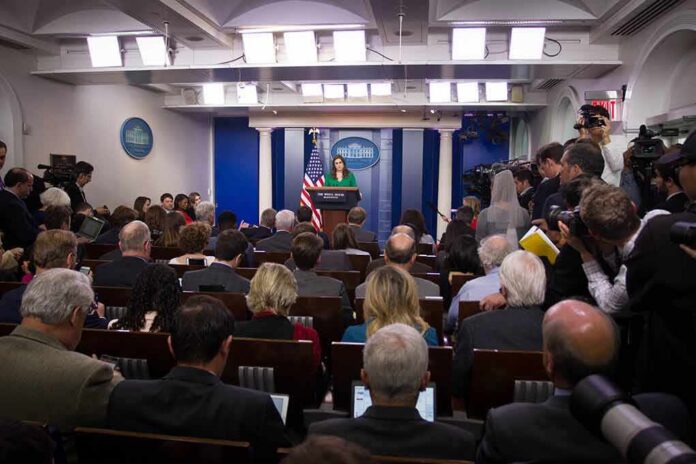
The White House press secretary occupies one of the strangest jobs in American government: the only senior position whose entire function is to stand in front of cameras and speak, under oath to no one, for a president who may or may not agree with what gets said next. Katie Zacharia’s elevation to that podium is less a personnel story than a case study in how presidents choose their voice.
Key Points
- President Trump offered Katie Zacharia the press secretary post, with a White House official confirming the offer on October 9, 2026, and Trump subsequently announcing the appointment directly on Truth Social.
- Zacharia succeeds Karoline Leavitt, who left the role at the end of August 2026 after the birth of her second child, leaving the post vacant for more than a month.
- Zacharia brings a background as a Department of Homeland Security spokesperson, a Pepperdine-trained lawyer, a conservative media commentator, and a senior communications adviser at Trump Media & Technology Group.
- During the vacancy, the administration leaned on cabinet secretaries and Vice President Vance to brief reporters rather than holding regular formal press briefings.
- The timing — weeks before the November congressional elections — places heavy weight on how quickly and effectively the new press secretary can organize the administration’s public messaging.
What Happened and When
On October 9, 2026, multiple outlets reported that President Trump had offered Katie Zacharia the position of White House press secretary, with a White House official confirming the offer directly to Fox News Digital and The Hill. A White House official told TheWrap in near-identical language: “The President has offered Katie Zacharia the position.” Trump then moved beyond background confirmation, announcing the appointment himself on Truth Social and telling reporters outside the White House that Zacharia “is going to be the press secretary… I think, terrific.” Zacharia responded publicly, thanking the president for what she called “the honor of a lifetime” and noting that “following the fabulous Karoline Leavitt is a high standard.”
She succeeds Leavitt, who departed the post at the end of August 2026 following the birth of her second child. The gap between Leavitt’s exit and Zacharia’s arrival ran more than a month — an unusually long vacancy for a role that typically changes hands in a matter of days once a president has settled on a successor.
Who Katie Zacharia Is
Zacharia arrives with a résumé built for exactly this moment rather than for traditional press-corps management. She is a graduate of Pepperdine University and its Caruso School of Law, briefly served as a spokesperson and deputy assistant secretary for public affairs at the Department of Homeland Security, and spent recent years as a conservative media commentator with regular appearances on Fox News and Newsmax. Most notably, she has worked as senior communications adviser to Trump Media & Technology Group, the company behind Truth Social — a relationship that places her inside the president’s own media apparatus well before she ever reached the West Wing podium. Trump, in his Truth Social announcement, emphasized her campaign work in battleground states, crediting her involvement in races the campaign swept “seven out of seven,” and praised what he called her “unblemished record of support” for the movement.
The Mechanics of the Job She Is Inheriting
The press secretary’s formal function, as scholars of the office describe it, is to serve as the administration’s information conduit — creating and disseminating the official record of the president’s statements, actions, and reactions to the world, while managing the daily friction between three audiences whose interests rarely align cleanly: the president, the White House staff, and the press corps itself. Political scientists who study the modern presidency describe the press office as having evolved, since the Reagan era, into something closer to a command center for directing public attention on the administration’s preferred terms rather than a passive clearinghouse of information. That evolution matters here because the job Zacharia inherits is not simply answering questions; it is architecting which questions get asked, in what order, and with what degree of administration control.
That control had visibly slipped during the vacancy. With no secretary holding the podium, the administration relied on cabinet officials and the vice president to field reporters’ questions on an irregular, ad hoc basis — a departure from the daily-briefing rhythm Leavitt had maintained and one that left the administration’s messaging operation without a single, consistent public face for more than a month. Restoring that rhythm, rather than merely filling a title, is the practical task now facing Zacharia.
Why the Timing Carries Extra Weight
Personnel changes at the podium rarely happen in a vacuum, and this one lands in a particularly charged window. The appointment comes roughly a month before the November congressional elections, a period in which the administration is working to consolidate messaging around the president’s legislative agenda and to shore up support for congressional Republicans on the ballot. A press secretary’s first weeks typically set the tone for how aggressively — or how defensively — an administration engages with scrutiny during a politically consequential stretch, and Zacharia’s background as a committed media surrogate suggests the administration is prioritizing message discipline and loyalty over institutional continuity with the press corps’ traditional expectations.
HUGE SHOUTOUT TO KATIE ZACHARIA!
President Trump’s reported pick for the next White House Press Secretary.
Are you happy with this selection?? pic.twitter.com/2guBbFB0sj
— Perlina Trump (@perlinaino) October 10, 2026
What the Transition Signals Going Forward
History offers a useful lens here: press secretaries have long functioned less as neutral spokespeople and more as the president’s first line of public defense, a pattern documented across administrations dating back to the role’s postwar solidification. Zacharia’s selection — a commentator and campaign-aligned communicator rather than a career press-office staffer — fits a broader pattern of recent administrations drawing press secretaries from allied media ecosystems rather than from the professional press-relations bench. Whether she restores the daily briefing cadence the press corps has come to expect, or instead continues the more selective, combative posture the administration has shown toward outlets it considers unfriendly, will be the clearest early signal of how this presidency intends to manage its final stretch before voters render judgment at the midterms.
Sources:
cbsnews.com, noticias.foxnews.com, foxnews.com, yahoo.com, axios.com, reference-global.com, socialsci.libretexts.org, en.wikipedia.org, academic.oup.com
© featurednews.com 2026. All rights reserved.