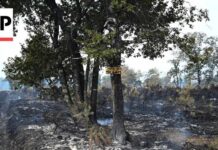
President Donald Trump is drawing a hard line with Canada, demanding they stop wildfires that are choking American cities with smoke and warning that the “cost of this pollution” will be slapped onto tariffs Canadians already pay.
Story Snapshot
- Trump says Canadian wildfires are poisoning U.S. air and disrupting daily life, calling it “willful negligence.”
- The president threatens higher tariffs on Canadian goods to cover economic damages from repeated smoke events.
- Dense smoke from hundreds of Canadian fires has triggered health alerts for millions of Americans in major cities.
- Canadian officials insist they are fully mobilized against the fires, pushing back on blame from Washington.
Trump Blasts Canada Over ‘Poisoned’ U.S. Air
United States President Donald Trump has linked a fast-moving wildfire crisis in Canada directly to the health and pocketbooks of American families. In a Truth Social post, he said the United States is being “unnecessarily invaded by filthy, polluted, and unhealthy air” drifting south from Canadian fires, calling the situation dangerous and totally unacceptable. Trump accused Canada of failing basic forest management and described its handling of brush and timber as “Willful Negligence,” in capital letters for emphasis.
Trump’s anger is not just about smoke; it is about money leaving American wallets. He argued that repeated smoke events from Canada are now a yearly pattern, costing the United States “Billions of Dollars” in lost work, business closures, and health impacts. In follow-up remarks covered by television outlets, he complained that the smoke is “poisoning our air” and forcing companies in cities like Detroit and Chicago to shut down outdoor operations and events to protect workers and customers. For a president focused on American industry, he framed these fires as a direct attack on U.S. economic stability.
Smoke From Canadian Fires Hits American Cities Hard
The smoke Trump is talking about is not abstract; Americans are seeing it every day. Nearly 900 active wildfires have been burning across Canada, many out of control, with a large cluster in northwestern Ontario sending thick plumes of smoke into the northern United States. Major cities including New York, Washington, Chicago, and Detroit have reported haze that blocks views of landmarks like the Empire State Building and Washington monuments, while residents report breathing problems and eye irritation.
Health officials in affected states have issued “unhealthy” air quality alerts, told people to stay indoors, and even handed out free masks due to the danger of inhaling fine particles from the smoke. Summer camps have moved activities inside, concerts have been rescheduled, and at least one beach along a popular lake has been closed because of the poor visibility and health risk. In some areas, thick haze has caused flight delays as pilots and towers struggle with low-visibility conditions. These concrete disruptions give weight to Trump’s claim that the costs of pollution are not just numbers on a page, but canceled plans, lost paychecks, and added medical risks for millions.
Tariffs as a Weapon Against Environmental ‘Negligence’
Trump’s main policy response is to reach for a tool he has used before: tariffs on Canadian goods. He has already raised some duties in previous trade battles, and this time he says the “cost of this pollution must of necessity be added to the tariffs Canada is currently paying.” In his social media post, he promised to call Prime Minister Mark Carney to demand action and warned that higher tariffs are on the table if Canada does not improve forest management and limit smoke crossing the border.
News outlets report that Trump’s team is examining which Canadian exports could face steeper tariff rates if the president follows through. Past moves have focused on lumber, steel, and agriculture, and experts warn that adding a pollution-based tariff layer could drive up prices for building materials, energy, and groceries inside the United States. However, Trump’s supporters see tariffs as the best way to make foreign governments feel the pain when their policies hurt American workers and families. By tying tariffs to environmental harm, he is sending a message that cross-border pollution is no longer “free” for trading partners.
Canada Mobilizes Fire Response and Pushes Back
Canadian leaders, especially in Ontario, strongly reject the idea that they are sitting on their hands. Ontario Premier Doug Ford says his government is “not sparing financial and personnel resources” as northwestern Ontario is besieged with wildfires that have forced evacuations and sent smoke south into the United States. Provincial briefings describe nearly 190 active fires across the north, with dozens threatening communities and forcing thousands of residents to leave their homes. Ford stresses that protecting people and property is the number one goal.
Trump warns communists in control of Canada to start getting control of the Canadian wildfires – videohttps://t.co/6k9cSj2CIA
— Proselytizer (@Proselytizer18) July 21, 2026
As evacuees stream into safer cities, Ford has opened reception centers for displaced families and urged them not to return home early, saying that doing so could jeopardize firefighting efforts. Canadian media report that more than 650,000 hectares have already burned this season, with air quality warnings covering wide stretches of Ontario and beyond. In response to complaints from U.S. politicians, Ford has defended his wildfire budget and said his government is fully mobilized, calling some of the foreign criticism “rubbish” and asking American leaders to send help instead of just “chirping” about smoke on television. This sharp pushback shows how quickly a shared environmental emergency can turn into a political fight between close allies.
Politics of Blame in a Cross-Border Crisis
This standoff fits a broader pattern seen in many countries when crises cross borders. Researchers studying blame during environmental disasters say nearby nations with strong symbolic meaning often get targeted, even when the science is complex and responsibility is hard to assign. In this case, Trump’s talk of Canadian “willful negligence” matches what scholars call “climate whataboutism,” where leaders shift focus from their own policies by stressing other countries’ failures. For Trump, framing the smoke as Canada’s fault also lines up with an “America First” trade posture that treats tariffs as a lever not only for trade deficits, but now for pollution costs.
For conservative Americans, the core concern is simple: families should not have to breathe dirty air or pay higher bills because another government will not manage its forests. Trump’s supporters view his threats as defending national sovereignty, economic security, and basic health against a foreign partner they feel has taken U.S. patience for granted. At the same time, the research shows that citizens rarely hold their own leaders fully accountable for air pollution, making it easier for politicians everywhere to point fingers across borders. As the smoke keeps rolling in, the pressure will rise on both Washington and Ottawa to decide whether this is mainly a trade fight, an environmental emergency, or both at once—and who ultimately pays.
Sources:
youtube.com, bbc.com, 1059theregion.com, toronto.citynews.ca, netnewsledger.com, ctvnews.ca, nowtoronto.com, cbc.ca, tandfonline.com, saisreview.sais.jhu.edu
© featurednews.com 2026. All rights reserved.