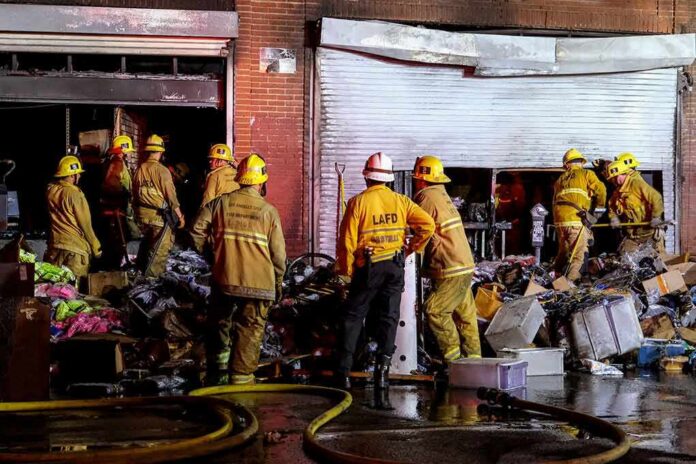
Los Angeles is fighting two fires at once: the literal daily blazes tied to encampments and the operational strain that constant, low-level combustion imposes on a big-city fire department built for infrequent catastrophes, not 47 new ignitions every day.
At a Glance
- LAFD recorded 12,241 fires tagged “Homeless or Encampment Related” from Jan. 1 to Sept. 20 — roughly 47 per day
- Volume is down about 6% year over year, but still a dominant, daily workload driver
- Most are trash/rubbish fires; hundreds involve brush, vehicles, or structures
- Hotspots cluster along freeway corridors and in dense encampment areas such as Skid Row
What the numbers say, and what they actually measure
The Los Angeles Fire Department’s incident logs show 12,241 fires classified as “Homeless or Encampment Related” through Sept. 20 — a cadence that averages to 47 fires every day citywide. The classification is broad by design: it captures fires started in encampments, ignitions adjacent to encampments, and incidents in which on-scene conditions linked the fire to unhoused living arrangements. That breadth matters for prevention and policy, but it doesn’t diminish the operational reality for crews: they must roll, assess, and put the flames out either way. The total is about 6% lower than the same period last year — evidence that volume can move with conditions and enforcement — yet the absolute level remains punishing.
Composition tells you why it feels relentless on the street. More than 10,000 of these incidents are trash or rubbish fires — small by individual footprint but incessant in frequency. Beyond nuisance fire volume, LAFD logged 189 vegetation or brush fires, 173 vehicle fires, and 153 structure fires tied to this classification over the same period. A trash burn that licks into a palm frond can become a brush fire; a candle inside a makeshift shelter can become a structure fire when it spreads to a fence line or adjacent carport. Fire behavior follows fuel and wind, not intent.
How daily fireload reshapes operations
Fire departments are staffed and positioned to meet peak demand within acceptable response-time thresholds while preserving capacity for the rare, high-severity event — a major structure fire, a multi-casualty crash, a wind-driven brush fire. Hundreds of small ignitions per week chew away at that reserve. LAFD’s rapid-response units, equipped with skid tanks and shorter hose lays, exist precisely to move quickly on rubbish and encampment fires so that engines and trucks can stay available for higher-acuity calls; even so, firefighters describe five, ten, sometimes fifteen rubbish fires in a single tour on these units. The cost is not theoretical: every out-of-service minute for a company erodes geographic coverage and increases the odds of delayed arrival to a stroke, a house fire, or a freeway pileup.
Patterns concentrate the problem. ABC7’s analysis highlighted hotspots along the 110 freeway corridor and inside Skid Row, where a single grid recorded 77 fires in the year-to-date window. Freeways and riverbeds offer linear, semi-sheltered spaces where people can survive; they also provide fuel beds — trash, pallets, brush — and wind channels that can turn a cooking flame, a warming fire, or a sabotaged power tap into a public-safety event. That geography forces repetitive redeployments: the same streets, the same underpasses, the same tree lines.
How we got here: a long-running, documented linkage
Los Angeles did not discover the connection between encampments and urban fire risk this year. LAFD data going back several cycles have shown a large and growing share of city fires associated with homelessness; a Los Angeles Times review reported that from 2018 through 2024, homelessness was a factor in roughly a third of all fires in the city. Earlier reporting captured a surge to about two dozen homeless-related fires per day in 2021, with subsequent years sustaining high volumes as encampments proliferated and fuel loads accumulated in public spaces. The city’s own strategic plan acknowledges the risk and directs coordination with homelessness response agencies to reduce encampment fires, codifying the problem as a standing operational priority rather than a transient anomaly.
This is also a policy story. When the City Council advanced authority to clear hillside encampments at severe fire risk, the rationale was blunt: in very high fire hazard severity zones, a small ignition can become a neighborhood-scale disaster. The broader literature and agency filings echo the same through-line: encampments concentrate ignition sources in fuel-rich settings, increasing both the frequency of small fires and the probability of a serious one. The result is not merely more calls; it is a different risk posture for a metropolis ringed by chaparral and cut by transportation corridors.
Causation, classification, and the prevention toolbox
“Homeless or Encampment Related” is a practical field label, not forensic proof of intent in every case; it captures proximity and circumstance because prevention depends on both. That nuance should guide interventions. Trash fires call for debris abatement and regular sanitation; cooking and heating fires call for safer equipment, fuel alternatives, and outreach; structure and vehicle fires linked to squatting or grid theft call for faster nuisance abatement, better property management, and targeted enforcement. LAFD’s incident mix underscores that no single lever will bend the curve — and that response-only strategies are expensive by design.
Where governments have moved upstream, the logic has been multipronged: increase low-barrier shelter and interim housing to reduce outdoor ignition sources; clear the most hazardous sites with coordinated offers of placement; harden properties vulnerable to trespass; and keep high-risk corridors on short sanitation cycles. The mayor’s office has framed encampment removals — more than 1,000 according to a recent statement — as part of that safety footing, alongside commitments to expand housing and services. The point is not to criminalize poverty; it is to interrupt the specific conditions that are generating daily fire volume while pathways off the street scale up.
Firefighters stretched to breaking point after homeless people spark over 12K fires in Los Angeles https://t.co/QJHno1mZps pic.twitter.com/6ALeaexreT
— New York Post Metro (@nypmetro) September 26, 2026
What it means for residents, businesses, and crews
For residents and businesses, the immediate reality is visible: smoke columns at freeway interchanges, scorch marks under overpasses, the unnerving knowledge that a shed, fence line, or carport can ignite from a small flame across the alley. For firefighters, it is the grind — a rising proportion of tours spent chasing ignitions that are usually small but occasionally catastrophic. For city leadership, it is an operational math problem with humanitarian stakes: reduce outdoor ignition opportunities fast enough to restore response-time headroom, without abandoning the imperative to house and stabilize the people now living where the fires start.
The figures are unsparing. Even with a modest year-over-year decline, 12,241 encampment-related fires in less than nine months reflect an urban system out of equilibrium. The historical record confirms this is not a blip but a persistent pattern. That combination argues for sustained, integrated work — housing and cleanup, abatement and outreach, enforcement and services — measured not only in people sheltered but in fewer daily dispatches to flames that never needed to start.
Sources:
nypost.com, latimes.com, abc7.com, kfiam640.iheart.com
© featurednews.com 2026. All rights reserved.