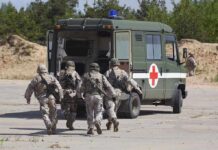
The Pentagon’s decision to pull 5,000 U.S. troops from Germany is turning a long-simmering NATO burden-sharing fight into a high-stakes test of America’s leverage during an active Iran conflict.
Story Snapshot
- The Pentagon says 5,000 troops will leave Germany over 6–12 months, bringing U.S. levels in Europe back toward pre-2022 numbers.
- The drawdown follows a public rift between President Trump and German Chancellor Friedrich Merz over U.S. strategy in the Iran war.
- Germany remains a core logistics hub for U.S. forces in Europe; the move reportedly affects major unit plans, including a cancelled deployment.
- NATO has sought clarification as allies weigh whether the shift is a one-off dispute or part of a longer U.S. retrenchment trend.
Pentagon Announces a 6–12 Month Drawdown From Germany
The Pentagon confirmed Friday, May 1, 2026, that the United States will withdraw 5,000 troops from Germany over the next six to 12 months. The move reduces the U.S. footprint in Europe to roughly pre-2022 levels, reversing some of the surge that followed Russia’s invasion of Ukraine under the prior administration. Public reporting indicates the plan includes pulling a brigade combat team and cancelling a long-range fires battalion deployment.
Germany has hosted roughly 35,000 to 36,000 U.S. personnel for decades, serving as the largest American basing and logistics platform on the continent. That role matters beyond symbolism: Germany’s infrastructure helps move personnel and equipment across Europe. While the Pentagon framed the shift as tied to “theater requirements,” officials also pointed to allied shortfalls in support related to the Iran war, sharpening the political message.
The Trump–Merz Clash Puts NATO Unity Under a Spotlight
The drawdown lands amid unusually direct public friction between President Trump and German Chancellor Friedrich Merz. Merz criticized the U.S. approach to the Iran war as humiliating and lacking strategy, while Trump signaled—via a Truth Social warning—that troop levels were under review and a decision was imminent. The timing makes it difficult to separate military posture from political signaling, even if force planning reviews were already underway.
For conservatives who have argued that NATO allies too often outsource security to American taxpayers, the decision looks like a familiar attempt to force a renegotiation of responsibility. For critics, including many on the left and some in Europe, the worry is that public disputes and troop moves create uncertainty that adversaries can exploit. The practical reality is that alliance credibility depends on predictable commitments, even while burden-sharing debates remain unresolved.
Iran War Pressure and Strait of Hormuz Risks Raise the Stakes
The withdrawal unfolds during an active U.S.-Iran conflict that reportedly began with U.S. and Israeli strikes on February 28, 2026, and that has strained transatlantic coordination. European leaders have complained about being left out of key decisions, while U.S. officials have highlighted expectations for allied support, including security concerns linked to the Strait of Hormuz. When energy routes and oil prices are at risk, every allied disagreement becomes economically consequential.
That economic dimension is where many Americans—right and left—tend to converge in frustration. Energy shocks travel quickly into household budgets, inflation, and broader cost-of-living pressures. The research provided does not quantify price impacts from this specific episode, but it does establish the link between the Iran war, Hormuz disruption risk, and heightened political tension. In that context, troop posture becomes part of a wider argument about strategy, consultation, and accountability.
NATO Seeks Clarity as Europe Weighs Self-Reliance
NATO officials have engaged the United States to understand the intent and scope of the drawdown, according to reporting that describes allies seeking clarity rather than declaring a rupture. Germany’s defense leadership reportedly called the reduction “expected” and used it to reinforce an argument for stronger European defense capacity. Separate reporting has also hinted the U.S. could consider adjustments in other countries such as Italy or Spain, though details remain limited.
US to withdraw 5,000 troops from Germany amid rift with NATO leaders https://t.co/JePERO4nQ7 via @YouTube
— Hebrew Yisrael (@hebrew_yisrael) May 2, 2026
An expert cited in the research, former NATO official Jamie Shea, described the development as continued “salami slicing” of the U.S. role rather than a dramatic full exit. That framing matters because incremental reductions can still change calculations for deterrence and logistics without a headline-grabbing abandonment. With limited public detail on which units go where, the key near-term indicator will be whether the U.S. pairs withdrawals with clearly communicated replacement capabilities or shared allied commitments.
Sources:
US Pulls 5,000 Troops From Germany Amid Iran War Rift With NATO Allies
US to withdraw 5,000 troops from Germany over 6-12 months amid Trump-Merz rift on Iran war
Failure to provide support: US to withdraw 5,000 troops from Germany amid widening Iran war rift
NATO seeks clarity as US to withdraw 5,000 troops from Germany amid rift with Europe