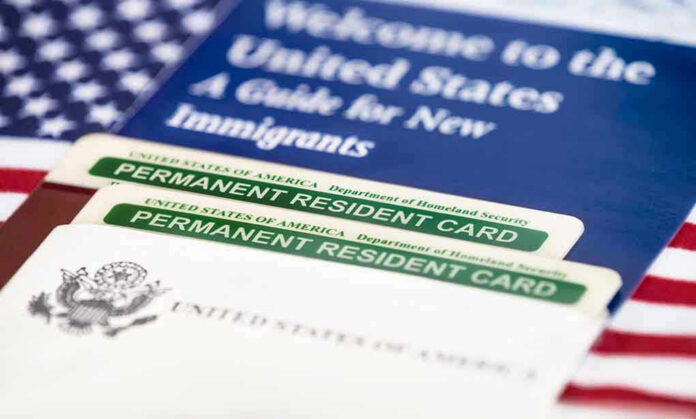
featurednews.com — Washington is quietly telling thousands of would-be Americans: if you want a green card, first get out.
Story Snapshot
- Trump officials are moving green card applicants from U.S. adjustment of status to overseas consular processing as the new “default.” [2][4]
- The same period brings tougher medical rules, paused cases, and expanded “public charge” scrutiny, multiplying risk and red tape. [1][3][6][7]
- Supporters frame the shift as restoring the original law and closing loopholes; critics call it a slow-motion shutdown of legal immigration. [3][5][7]
- Families, employers, and conservatives who value orderly, law-based immigration all have something at stake in this quiet rerouting of cases. [3][5][6]
What “You Have To Leave First” Actually Means
The rule fight starts with a dry phrase in immigration law: “adjustment of status.” That is the mechanism that has long allowed many foreign nationals already living in the United States to become permanent residents without leaving, so long as they were inspected, admitted, otherwise eligible, and a visa number was available. A new United States Citizenship and Immigration Services policy memorandum now tells officers to treat that path as an “extraordinary” exception, pushing most applicants to seek immigrant visas at United States consulates abroad instead. [2][4]
This change does not grab headlines like a border surge, but it flips the lived script for huge categories of people who followed the rules—spouses of citizens, high-skilled workers, long-time residents whose employers finally sponsored them. Under the memo, officers are instructed that the “real” process is consular, and in-country adjustment is discretionary “administrative grace” to be used sparingly. Commentators describe the marching orders bluntly: if you are here temporarily and want a green card, expect to go home and apply unless your case is truly exceptional. [2][4]
The New Web Of Medical Exams, Pauses, And Re-Checks
The departure push lands on top of several other Trump-era changes that already made green cards harder to secure from inside the country. United States Citizenship and Immigration Services announced that every new permanent residency application must include a current medical examination form, and that even many pending cases without the updated form on file would be denied, forcing some applicants to pay for exams more than once. [1][6] At the same time, reporting describes pauses in processing for certain green card categories, particularly refugees and asylees, while agencies rerun fingerprints and re-interview applicants. [3][5]
For people from travel-ban or security-flagged countries, the ground is even less stable. Guidance explains that pending applications, naturalization ceremonies, and even existing green card status may be frozen or re-reviewed, and that immigrant visa processing has been paused for individuals from dozens of countries while officials apply stricter “public charge” rules. [3][4][7] Layer on a new one hundred dollar asylum application fee and canceled policies that once protected stateless people or vulnerable youth, and the picture is clear: the entire adjudication environment is tightening, not just one obscure memo. [2][3][6]
The Fraud And Security Rationale, Tested Against Reality
Supporters of the departure requirement echo the administration’s language about restoring the “original intent” of the law and closing loopholes. They argue that forcing cases abroad reduces forum shopping, makes it easier to deny shaky files without creating due-process headaches inside the United States, and allows the Federal Bureau of Investigation and consular officers to cross-check biometrics more rigorously. [4] From a conservative perspective, the goals of preventing fraud, ensuring self-sufficiency, and demanding full compliance with the law are entirely legitimate, even essential, in a system that touches national sovereignty.
L.J. D'Arrigo, leader of Harris Beach Murtha's Immigration Practice Group, says the Trump administration's most recent immigration move means most foreign nationals temporarily in the U.S. seeking a green card will have to return to their home country to apply at a U. S.…
— Harris Beach Murtha (@HarrisMurtha) May 22, 2026
The question is not whether screening should be serious; of course it should. The question is whether the specific way this policy is built—broadly forcing out applicants with no individualized suspicion—actually targets bad actors or simply penalizes anyone without money and flexibility. The current record shows wide pauses and re-vetting of whole categories of people, including refugees, young immigrants with prior protections, and long-time green card holders from disfavored countries, rather than tailored fraud hunts supported by data. [3][5][6] That is a blunt instrument, not a scalpel.
Costs, Consequences, And What Common Sense Would Require
Sending a family back overseas to apply is not a paper exercise. It means plane tickets for multiple people, possibly quitting jobs, pulling children from school, and risking months or longer stuck abroad if a consulate is backlogged or temporarily shut. Employers who sponsored workers can lose hard-to-replace staff mid-project. None of these disruptions show up in a policy memo, but they are real, and they fall most heavily on those who cannot afford a long, unpaid exile while the State Department stamps their future. [3][5][6]
Yet the administration has not, in the material available, produced transparent numbers comparing fraud detection or denial rates between in-country adjustment and consular processing, nor a serious cost-benefit analysis of imposing departure as the baseline. [5][7] Common-sense conservatism usually demands exactly that: prove the problem, tailor the remedy, and avoid collateral damage to law-abiding families and the businesses that employ them. A policy that treats lawful presence and compliance as grounds for extra punishment—“because you did everything right inside the United States, you must now leave to finish the process”—sits uneasily with that ethic.
Sources:
[1] YouTube – Trump admin changes requirements for green cards …
[2] YouTube – Trump’s BIG changes to Green Card Adjustment of Status …
[3] Web – Trump Immigration Policy Changes – USAHello
[4] Web – Immigration: Recent Changes and New Regulations | Insights
[5] Web – Trump Administration Abruptly Stopped Processing Green Card …
[6] Web – New Green Card Rules 2026: What Immigrants Should Know Under …
[7] Web – Trump Administration Public-Charge Rule Would Ampl..
© featurednews.com 2026. All rights reserved.