When a senior White House adviser stands at the State Department and declares that the United States has “formally recognized left-wing violence as political terrorism,” he is not just giving a fiery speech; he is articulating a major shift in how the federal government intends to use its counterterrorism powers against domestic political actors.
Key Points
- Stephen Miller’s ministerial speech framed left-wing violence as formally recognized “political terrorism” and an existential threat to U.S. national security and republican government.
- He cited National Security Presidential Memorandum 7 (NSPM‑7) as a directive ordering law enforcement and intelligence agencies to “disrupt, identify, defund, debank, arrest, and prosecute” left-wing political groups.
- Rubio and Miller highlighted historical and recent far-left violence, including claims of an 8,000% rise in assaults on ICE officers and multiple assassination attempts, to justify a global crackdown.
- The policy turn sits alongside data showing a recent uptick in far-left incidents from a low baseline, but with right-wing extremism still responsible for the bulk of domestic terrorist deaths.
- The strategy raises unresolved questions about evidence, legal authority, and the risk of using terrorism tools against broad swaths of civil society rather than tightly defined violent conspiracies.
Stephen Miller’s Case: Left-Wing Violence as “Political Terrorism”
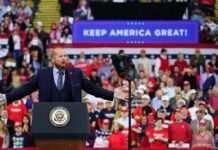
Stephen Miller’s speech at the State Department ministerial on the resurgence of political terrorism is best understood as a doctrinal statement: left-wing violence is to be treated not as sporadic criminality, but as organized “political terrorism” aimed at overthrowing the American constitutional order. Speaking to representatives from more than sixty countries, Miller asserted that the United States has “formally recognized left-wing violence as a form of political terrorism that is a direct threat to our national security and the survival of our republican form of government.” That recognition, he argued, justifies using the full architecture of national security law against domestic actors traditionally seen as protesters, militants, or extremists rather than foreign terrorist organizations.
Miller’s rhetoric is unvarnished. He described left-wing movements as a “fatal cancer to civilization,” cast their adherents as driven by envy and hatred rather than idealism, and insisted that their ultimate objective is to overturn republican government and impose repression and suffering. In his telling, what many Americans encounter as street protests, doxing campaigns, or aggressive online organizing are in fact components of a structured terror movement: Antifa as an “international network operating in dozens of countries,” encrypted coordination among militants, shared funding channels, and a deliberate strategy of armed resistance.
Crucially, Miller argued that this movement hides behind “pretextual and disingenuous appeals to civil liberties”—claims of free speech, assembly, or anti-fascist motives—which he urged governments to “ignore” for purposes of prosecution. That framing goes beyond describing violence; it recasts legal and constitutional defenses as part of the threat itself, a move with far-reaching implications for how courts, juries, and investigators interpret dissent that turns confrontational.
NSPM‑7: A National Counterterrorism Strategy Targeting the Left
The centerpiece of Miller’s argument is National Security Presidential Memorandum 7, or NSPM‑7. In his speech, he presents NSPM‑7 as a watershed in U.S. national security policy: “for the first time in American history,” he said, it directs “all of our law enforcement and intelligence agencies to work together to disrupt, identify, defund, debank, arrest, and prosecute these political terrorists that are operating in our country.”
Presidential national security memoranda are the mechanism by which a president sets formal national security policy for the executive branch; they can quietly reorganize priorities and authorities without the public visibility of a statute. According to Miller, NSPM‑7 does several things at once. First, it labels left-wing violence as political terrorism. Second, it instructs agencies—from the FBI and Department of Homeland Security to financial regulators—to treat far-left networks as targets to be dismantled, not simply monitored or prosecuted piecemeal. Third, it explicitly incorporates financial tools: “defund” and “debank” signal an intention to freeze assets, sever banking relationships, and choke off funding in ways that have historically been used against jihadi or transnational criminal organizations.
The memorandum does not exist in isolation. The administration had already designated four far-left extremist groups as Foreign Terrorist Organizations (FTOs), with the State Department offering rewards of up to $10 million for information disrupting their financing. NSPM‑7 gives domestic content to that international policy by anchoring a national strategy of “countering domestic terrorism and organized political violence,” which calls for investigating and disrupting networks that “foment political violence” so law enforcement can intervene before attacks occur. Put plainly: the White House is trying to port the toolkit built for Al Qaeda and ISIS onto far-left movements it sees as systemically violent.
The Evidence Miller and Rubio Cite: History, Statistics, and Specific Incidents
Miller’s speech did not unfold in a vacuum; it was paired with Secretary of State Marco Rubio’s opening remarks, which provided a historical and comparative frame for the administration’s focus on far-left terrorism. Rubio pointed back to the wave of left-wing terrorism in the 1970s and 1980s: Latin American groups like the Tupamaros, Montoneros, FARC, ELN, and Shining Path, and European outfits such as the Red Brigades, Red Army Faction, and Greece’s “17 November,” which murdered the CIA station chief in Athens. He cited FBI data indicating that from 1970 to 1980, 93 percent of terrorist attacks in the West were carried out by far-left extremists.
Rubio then argued that a new resurgence is underway. He claimed that Germany had experienced a 40 percent increase in far-left violence over the prior year and that more than 80 percent of radical violence in Greece was now driven by anarchist and far-left actors. In the United States, he and Miller pointed to sniper attacks on immigration officers, violent assaults against ICE personnel, a transgender shooter targeting Catholic schoolchildren, the assassination of a healthcare executive, multiple alleged assassination attempts against President Trump, and the killing of conservative activist Charlie Kirk. Miller amplified one statistic in particular: an “8,000% increase in violent assaults on U.S. Immigration and Customs Enforcement (ICE) officers,” presented as emblematic of an organized campaign of armed resistance.
Some of these claims are grounded in identifiable data; others, at least in the public record, are not. The 93 percent figure for 1970–1980 appears in academic and governmental analyses of that era’s terror landscape. By contrast, the 8,000 percent ICE assault statistic is not traceable to a published methodology or official dataset in the material available, and Miller did not provide date ranges or sources in his speech. Likewise, assertions of multiple assassination attempts against President Trump, framed as part of a systemic campaign, lack accompanying case citations in the ministerial remarks, making it difficult to weigh their scope against broader incident data.
On transnational coordination, Rubio described far-left terrorists as operating across borders, sharing encrypted communications, safe houses, and funding, and being linked to hostile foreign states like Iranian proxy groups and Cuba’s intelligence networks. This reflects longstanding concerns about revolutionary movements’ foreign ties, but in the sources surveyed here, no declassified intelligence or court records are presented to substantiate specific operational relationships. The administration’s public case is, at this stage, more inferential than evidentiary on that front.
How the Broader Data Picture Looks: Upticks, Baselines, and Lethality
To evaluate Miller’s thesis, one must place it against the broader empirical landscape of political violence in the United States. Multiple independent analyses converge on a basic pattern: right-wing extremism has been the predominant source of domestic terrorism-related deaths since 2001, accounting for roughly three-quarters of fatalities. In recent years, however, far-left incidents have ticked up from a very low base. A Center for Strategic and International Studies (CSIS) report found that in the first half of 2025, far-left terrorist plots and attacks slightly outnumbered right-wing incidents—a reversal in incident counts, not in lethality.
The CSIS data and peer-reviewed studies emphasize two points relevant to Miller’s framing. First, the absolute number of far-left incidents remains small; CSIS’s alarm was based on five plots and attacks over seven months, representing a 400 percent increase from the prior year but still modest in total. Second, left-wing attacks tend to be less deadly than right-wing or jihadist violence, both in the United States and globally. Since 2020, only two fatalities have been attributed to left-wing terrorist attacks in the United States.
Analysts at Just Security and other outlets have therefore cautioned against reading the short-term uptick as evidence of a “vast domestic terror movement.” They argue that the evidence supports neither a simple surge narrative nor a simple decline narrative; the reality is a complex mix of low-frequency, low-lethality events against a background of far more deadly right-wing violence. That does not invalidate concern about far-left attacks, particularly when they target public officials or critical infrastructure. It does mean that the scale and lethality of the threat described in Miller’s speech substantially exceed what the available data currently document.
Legal Architecture and Civil Liberties: Where the Strategy Pushes the Boundaries
One of the most consequential aspects of the administration’s approach is its use of counterterrorism tools in a domestic context where the legal category of “terrorism” does not operate the way Miller’s rhetoric suggests. There is no standalone domestic terrorism statute in U.S. federal law; “domestic terrorism” is a definitional term that can predicate investigations but not charges. Former FBI agent Mike German notes that while 52 of 57 federal terrorism crimes can apply domestically, the expansive investigative powers and material-support provisions associated with international terrorism are significantly broader.
By designating far-left groups as FTOs and by promulgating NSPM‑7, the administration creates a bridge: domestic actors associated—sometimes loosely—with organizations labeled foreign terrorists can be targeted using international terrorism authorities, even when their conduct is primarily domestic. German and journalist Ken Klippenstein warn that this risks repeating the post‑9/11 pattern, in which Muslim American civil society organizations were surveilled, had assets frozen, or were prosecuted on attenuated theories of support without evidence of violent wrongdoing.
The ministerial speeches themselves signal an expansive view of who falls under the ambit of “political terrorism.” Miller spoke not only of militants but of judges, jurors, and prosecutors he believes are “shielding” left-wing extremists. He alleged “jury nullification” in Washington, D.C., and New York City—jurors supposedly refusing to convict left-wing defendants for political reasons—without providing case names or conviction statistics. Paired with a directive to “defund” and “debank” organizations, this creates a picture in which a wide array of actors around contentious protests and movements could find themselves treated as part of a terror-support ecosystem rather than as participants in political contention.
Why This Matters: Mechanism, Precedent, and Potential Trajectory
The political stakes of Miller’s speech are obvious, but its deeper significance lies in the mechanism it describes: a formal reclassification of a segment of domestic political activity as “terrorism,” coupled with a strategy to mobilize the full spectrum of national security authorities—from criminal prosecution and surveillance to financial sanctions—against it. Once such a framework exists, it becomes available not only for the cases that most observers would recognize as terrorism (assassinations, bombings, sniper attacks), but for more ambiguous forms of disruptive protest, radical organizing, or aggressive speech.
Historically, U.S. counterterrorism policy has oscillated between dismissing ideological threats as marginal and inflating them to justify expansions of state power. Miller’s ministerial marks a swing toward maximal inflation with respect to the far left. The past provides cautionary tales: COINTELPRO against civil rights and antiwar activists; the use of “material support” charges against charities and mosques in the 2000s; and episodic labeling of environmental and animal-rights activists as “eco-terrorists” despite low lethality. Each episode generated long-term civil liberties concerns and, in many cases, institutional regret.
What follows from NSPM‑7 and the rhetoric around it will depend on how rigorously agencies differentiate between genuine terrorist conspiracies and broader political movements that include both lawful and unlawful elements. If the focus remains tightly on planned lethal attacks and clearly defined violent networks, the strategy will resemble past efforts against right-wing militias and jihadi cells. If, however, “disrupt, defund, debank, arrest, prosecute” is applied to a wide spectrum of organizations on the basis of ideology and proximity, the United States could see a new era in which domestic political opposition is routinely entangled with terrorism designations.
Sources:
thegatewaypundit.com, youtube.com, archive.org, trumpwhitehouse.archives.gov, foxnews.com, c-span.org, podcasts.happyscribe.com, state.gov, splcenter.org, npr.org, en.wikipedia.org, hstoday.us, pbs.org, justsecurity.org, pmc.ncbi.nlm.nih.gov
© featurednews.com 2026. All rights reserved.