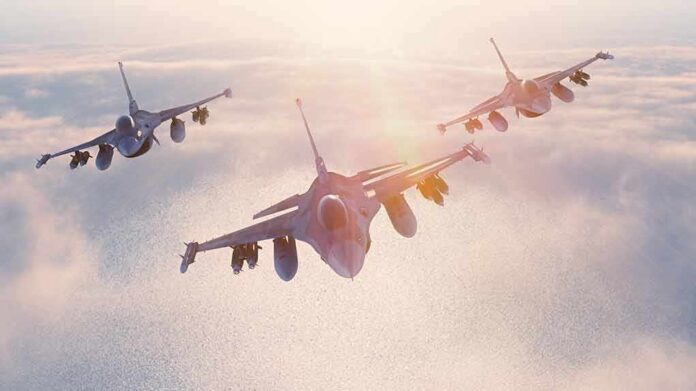
In the first hours of September 11, when U.S. air defenses were scrambling unarmed fighters into a battlespace they barely understood, two Air National Guard pilots launched from Andrews knowing the only way to stop a hijacked airliner might be to ram it. That stark contingency—deliberate midair collision as last resort—was real, planned in cockpit shorthand, and aligned with national shootdown authority moving through the chain of command as the crisis unfolded.
The Short Version
- Two D.C. Air National Guard F-16s launched unarmed and prepared to ram United 93 if it reached Washington.
- The pilots—Marc “Sass” Sasseville and Heather “Lucky” Penney—divided targets: cockpit and tail, to disable control surfaces.
- National leaders had authorized lethal force; the order’s transmission lagged behind the events in the air.
- Ram tactics were born of necessity: no missiles, no time, and a federal air-defense system straining under communications failures.
The emergency intercept, stripped to essentials
The D.C. Air National Guard launched a pair of F-16s from Andrews without missiles or live ammunition; there was no time to arm and few clear tracks to chase. In their cockpit huddle, Lt. Col. Marc Sasseville and 1st Lt. Heather Penney settled the only tactic available to stop a heavy airliner: use their jets as kinetic weapons. Sasseville would take the cockpit; Penney would take the tail, severing control to induce loss of lift and controllability. Multiple institutional accounts and Penney’s own retellings align on this point: the sortie was, by design, a ramming mission if interception became possible.
That is not romantic hyperbole after the fact; it is how experienced fighter aircrews solve an unsolvable problem when speed, geometry, and physics leave no other option. A modern airliner’s flight controls and engines are its vulnerabilities. Remove or disable them and the airplane will not reach target. Against the clock, with Washington in the crosshairs, that was the plan.
How national authority and cockpit decisions met in the fog of war
At the national level, lethal force against hijacked aircraft was authorized at the top of the chain. President George W. Bush and Vice President Dick Cheney discussed shootdown authority as the attacks unfolded, and Cheney relayed that authority into the military command system; the 9/11 Commission records and later releases describe that transfer of decision rights plainly. The timing was brutal. The Commission concluded that shootdown authorization reached the air-defense sector after United 93 had already crashed in Pennsylvania, an emblem of how fast the operational picture was moving relative to command-and-control plumbing.
Inside that window, the ramming contingency sat alongside the national order: the former was a tactical expedient born of empty weapons rails; the latter was a presidential-level policy decision. They are separate questions that happened to converge that morning—proof that decisive authority matters, but so does what a specific crew can actually do in the next ten minutes.
Why ramming was on the table: mechanism, physics, and procedure
Interception is a geometry problem solved at speed. On 9/11, several constraints collapsed the option set. First, the Andrews alert aircraft were not sitting cocked with live missiles for domestic hijack duty; arming takes time and coordination. Second, the air picture was confused; Federal Aviation Administration feeds and NORAD sectors struggled to reconcile flight plans, transponder losses, and reports from multiple sources. In that environment, an unarmed intercept remains valuable for identification and signaling, but it cannot disable a hostile aircraft at standoff. Hence the brutal logic: use the F-16 itself as a weapon against a vital node—cockpit or tailplane—to break control and end the flight before it reaches a populated target.
The tactic was not in peacetime hijack checklists; pre-9/11 protocols contemplated escort and negotiation, not kinetic defeat of a domestic airliner. But pilots are trained to mission-plan under constraint. Penney has described aiming at the tail to “aerodynamically unbalance” the aircraft—an accurate way to explain how removing stabilizer authority forces an uncontrollable departure from flight.
What the documentary record actually supports
The core facts are anchored by institutional and primary accounts. The National Museum of the U.S. Air Force identifies Penney as “known for flying a ramming mission to prevent United Airlines Flight 93 from reaching Washington, D.C.,” formal language rare in museum curation unless corroborated. Contemporary and retrospective reporting from mainstream outlets has repeated the same tactical division-of-labor—Sasseville to the cockpit, Penney to the tail—based on direct interviews with the pilots. And public histories of the military’s 9/11 response note that had United 93 broken through to the capital, those unarmed F-16s were prepared to give their lives to stop it.
On the policy side, the documented shootdown authority and its transmission cadence come from the 9/11 Commission’s report corpus and supporting materials. Those records are clear: national authorization existed; sector-level communication lagged; and the window closed before armed interceptors could apply it to United 93. Together, these streams of evidence make the ramming mission neither myth nor embellishment but a last-ditch tactic nested inside a broader, authorized air-defense response.
Why this matters beyond 9/11 lore
Three enduring lessons sit inside this episode. First, readiness is not only about hardware on the ramp; it is about command-and-control latency. You can have the right authority and the right aircraft yet still lose the critical minutes to ambiguous tracks and message routing. The post-9/11 air-defense enterprise has since re-wired domestic warning, decision, and engagement pathways to compress that latency, including alert postures, integrated sensors, and standard rules for lethal force inside U.S. airspace. Second, pilot initiative remains the last safeguard. No checklist can anticipate a weaponless intercept against a hijacked widebody; judgment does the work when doctrine runs out. Third, public memory often fuses distinct issues—shootdown law, interception mechanics, and a specific crew’s intentions—into a single narrative. Untangling them clarifies responsibility and preserves the credibility of the people who shouldered it.
The human dimension: duty under extreme constraint
It is easy, at twenty years’ distance, to abstract the decision to “ram” into a rhetorical flourish. It was not. It was a finite, physical plan spoken aloud in a cramped cockpit by two professionals who understood energy management, structural loads, and what colliding with a transport category aircraft at high subsonic speed would mean for their own survival. The plan existed because the time did not. The country’s capital needed minutes bought at any price, and two pilots were prepared to pay it. That is the irreducible center of this story—and the standard by which any future domestic air-defense posture should be judged.
Sources:
military.com, heatherpenney.com, foxnews.com, en.wikipedia.org, abcnews.go.com, journalof911studies.com, cla.purdue.edu, independent.co.uk, americanradioworks.publicradio.org
© featurednews.com 2026. All rights reserved.