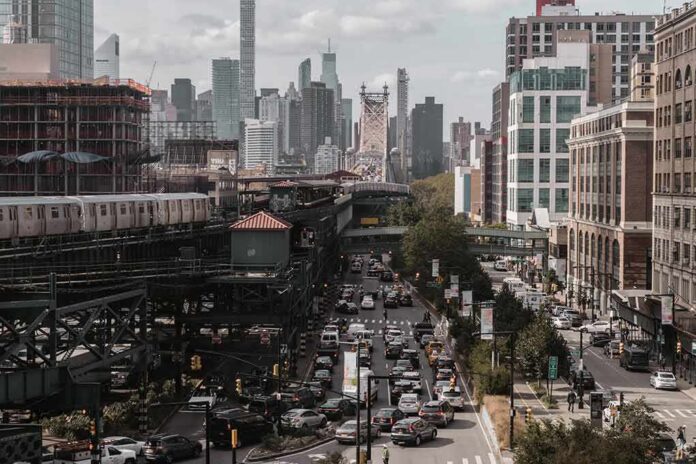
A four-block stretch of Pennsylvania Avenue in East New York has functioned as an open-air sex trafficking market for years, and federal cases have now established not just the coercion behind it but the violence that enforces it.
At a Glance
- Federal prosecutors and court outcomes identify the “Penn Track” as a concentrated corridor of street-based commercial sex built on force, fraud, and coercion.
- Traffickers moved women across state lines and used threats and violence to control earnings and mobility.
- A Brooklyn jury convicted a trafficker for conduct on the Penn Track, including coercion involving a minor.
- A separate case tied the market to a retaliatory murder over control of a victim; the organizer received a 50-year sentence.
What law enforcement has established about the Penn Track
The Department of Justice and the U.S. Attorney’s Office for the Eastern District of New York have, across multiple actions, described the Penn Track as an open-air sex trafficking market anchored along Pennsylvania Avenue near Wortman and Georgia Avenues in East New York. Charging documents and press materials outline the same pattern: men recruiting and moving women into the corridor, compelling them to sell sex, controlling where and when they work, and extracting their earnings through force, fraud, and coercion. These are not isolated references. Over a series of cases, prosecutors detailed the use of threats, violence, and psychological manipulation to keep victims compliant and on the track.
Interstate movement is a recurring element. In one indictment, the government alleges that women were transported from New York to other states for commercial sex, with the Penn Track serving as a base of operations and visible marketplace for customers and control. This mobility—core to modern trafficking—serves both commercial reach and tactical evasion, moving victims between jurisdictions while preserving the same on-street pipeline of buyers at home.
From allegations to verdicts: what courts have already decided
Not all of the Penn Track story is in the charging posture; a portion has been adjudicated. A Brooklyn federal jury convicted Joel David Forney for sex trafficking women at the Penn Track, including coercion and enticement of a minor. The government proved the use of force, fraud, and coercion—elements that distinguish trafficking from consensual adult sex work and that meet the statutory thresholds under federal law. A separate prosecution culminated in a 50-year sentence for Omari Scott for sex trafficking and for orchestrating the murder of a rival pimp during a dispute over control of a trafficking victim—a case that connects the marketplace’s economics to lethal enforcement of territory and “ownership” of women.
These outcomes matter because they convert the corridor’s reputation into judicially tested facts for specific actors. While no single verdict can describe every transaction on the avenue, the record now includes a jury’s findings and a lengthy sentence that together confirm the core claims: women were trafficked at the Penn Track, minors were targeted, and violence—including murder—was an instrument of control tied to the market’s operation.
How an open-air trafficking market operates
Street-based commercial sex clusters in predictable corridors: places with steady vehicular flow, low rent or transitional land use, buffered visibility, and a customer base willing to drive predictable loops. The Penn Track fits that template. Buyers approach by car, negotiations occur at curbside, and sex acts happen in vehicles or nearby motels. Pimps and traffickers manage rotation, set quotas, collect earnings, and punish deviation. Coercion spans a spectrum—physical assault, threats against family, debt bondage, addiction leverage, and confiscation of identification—each designed to narrow a victim’s perceived choices to one: stay, work, and pay.
Moving women across state lines compounds control. It breaks local support networks, exploits jurisdictional seams, and keeps victims off balance. When a corridor like the Penn Track becomes a dependable storefront for buyers, it also becomes a stable point of extraction for traffickers, who can plug in new victims while moving others along a wider circuit.
The geography and its persistence
Place-based sex markets endure because they align supply, demand, and permissive space. Academic work on New York City confirms that street sex concentrates in hot spots shaped by transit, land use, and social vulnerability; interventions may scatter activity briefly, but durable corridors reconstitute absent sustained, multi-front strategies. That is why the Penn Track has endured through cycles of enforcement. Local coverage and police ride-alongs have described the same stretch of Pennsylvania Avenue as a persistent cluster of solicitation and pimp presence, visible to passing motorists and officers alike.
Even as trafficking prosecutions mount, reporting indicates the corridor remains active and conspicuous: women negotiating at the curb, steady lines of cars, and low-dollar transactions that keep the volume high and the footprint constant. Public-nuisance complaints—congestion, noise, litter—are symptoms of the underlying market, not the disease.
Where the record is strongest—and where it is narrower
The strongest evidence about the Penn Track is case-bound. Federal indictments, convictions, and sentences delineate specific conduct: where and how individual defendants trafficked women, the means of coercion they used, and, in one instance, a murder tied to control of a victim. That record establishes the corridor as a site of trafficking activity and demonstrates that violence is not incidental to the business model. It does not, however, function as a census of every person visible on the avenue at any given hour. Street-level scenes can blend coerced trafficking with independent adult sex work; only investigative process—interviews, forensic financials, service-provider assessments—can parse that mix case by case.
The absence of a comprehensive count does not blunt the legal reality documented to date: prosecutors have proved trafficking occurred at the Penn Track, including of a minor, and that a homicide stemmed from a rivalry over victim control. Those are not atmospherics; they are adjudicated facts for named defendants that define the corridor’s risk profile.
Why enforcement alone doesn’t dissolve the market
Open-air markets respond to incentives. If buyers face minimal risk, pimps retain informational advantage, and victims lack safe exits, demand and supply will reconverge after any sweep. Traditional vice enforcement that targets the most visible, least powerful participants—usually the women—may shuffle the deck without altering the game. Conversely, sustained trafficking prosecutions, when paired with demand-side deterrence and robust services for victims, can dismantle the controlling infrastructure: phones, drivers, hotel relationships, and the coercive leverage that keeps women on the curb. The Penn Track cases represent that higher-leverage approach—taking aim at the organizers and the violence that underwrites their earnings.
Still, durability is the rule until incentives change. Criminological studies of street sex markets in New York show recurring hot spots across decades; effective responses layer prosecution of traffickers, disruption of buyer flow, environmental design changes, and guaranteed pathways out for victims who are ready to leave.
What it means going forward
The Penn Track is not an abstraction—it is a functioning marketplace for coerced sex, anchored by repeat buyer traffic and enforced, at its worst, by lethal violence. The federal record has moved this from rumor to proof for multiple defendants, including a jury conviction involving a minor and a 50-year sentence that links the corridor to a retaliatory killing. That lifts the policy discussion above debates about optics or nuisance. It is about dismantling a business model that treats human beings as contested property.
The path forward is clear in outline if difficult in execution: continue high-impact trafficking prosecutions against organizers; pursue demand reduction that raises meaningful risk for buyers; disrupt the physical and digital logistics that make the corridor profitable; and fund durable services—housing, legal advocacy, addiction treatment—that convert rescue into exit. The geography will not change itself. Incentives will.
Sources:
nypost.com, justice.gov, yahoo.com, brooklyn.news12.com, abc7ny.com
© featurednews.com 2026. All rights reserved.