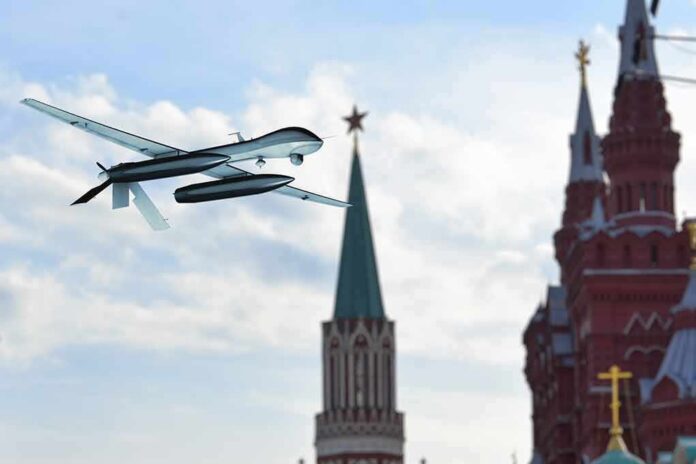
Massed, long-range drone salvos have moved from tactical experiment to strategic instrument in the Russia–Ukraine war, and the record-sized attack on Moscow during Russia’s parliamentary vote crystallizes why: volume, not individual warhead size, is now the variable that can penetrate air defenses, impose economic costs, and shape political theater at scale.
The Short Version
- Multiple credible outlets reported Ukraine launched over 1,000 drones across Russia, with hundreds aimed at Moscow; Russian officials called it the capital’s largest-ever drone assault.
- Russia acknowledged intercepting large numbers (claims range from 1,100 nationwide to 450 near Moscow) yet confirmed lethal impacts and damage at a Moscow oil refinery.
- The operation fits a clear trend: Ukraine is using inexpensive, long-range drones to pressure deep in Russia as both sides escalate volume to overwhelm air defenses.
- Election-day timing added political leverage; Russian officials framed the attack as an attempt to disrupt voting, while Ukraine emphasized striking military-relevant energy and logistics nodes.
What Happened: Scale, Aims, and Acknowledged Effects
The most defensible core facts are straightforward. Ukraine executed a mass, long-range drone operation across Russia; the reported volume exceeded 1,000 platforms in a single night, with several hundred directed toward the Moscow region. Russian authorities publicly corroborated the scale in two ways: first, Moscow’s mayor called it the capital’s “largest ever” drone attack; second, Russian defense channels claimed well over 1,000 intercepts nationally and stated 450 were downed en route to Moscow—figures that, even as propaganda, concede extraordinary volume. Despite interceptions, Russian officials acknowledged fatalities and damage, including impacts at the Moscow Oil Refinery in the city’s southeast—precisely the type of energy infrastructure Ukraine has methodically targeted to burden Russia’s war economy.
In wartime, numbers are narrative weapons: both sides inflate successes and downplay costs. But here the overlap matters. Independent and wire-service reporting converges on three outcomes—fatalities, refinery damage, and exceptional scale—grounded in statements from Russian municipal and defense sources as well as Western outlets that would have little incentive to embellish pro-Russian claims about impacts in Moscow. The precise launch count and intercept tally will always be contested; the material effect is not.
How Mass Drone Warfare Works: Attrition Through Volume
Large drone swarms invert the traditional air-defense equation. Classic systems—radars cueing surface-to-air missiles and gun systems in layered belts—are optimized for small numbers of high-value threats. Low-cost, small cross-section drones flying nap-of-the-earth trajectories complicate detection; when launched by the hundreds, they also saturate engagement capacity. Electronic warfare (jamming, spoofing) can divert or down a portion of the wave, and point defenses can thin it further, but the striker needs only some leakage to create operational effect. That is the new logic: leverage quantity to force expensive intercepts, stress command-and-control, and accept partial losses as the price of guaranteed penetrations.
Ukraine’s long-range drones—domestically iterated, road-mobile, and dispersed—extend reach far beyond the front. They are not magic bullets; warheads are modest, accuracy is partially contingent on contested navigation, and many vehicles are attrited en route. But the combination of range and volume lets Kyiv pick pressure points: refineries, fuel depots, and logistics nodes that, when repeatedly degraded, sap throughput and create price spikes and localized shortages. Publicly available reporting over the past year documents a steady rise in such strikes and scale, reflecting iterative manufacturing gains and doctrinal learning by Ukrainian unmanned forces.
Why the Election-Day Timing Matters
The strike’s choreography was not incidental. Russian officials argued the attack sought to disrupt the final day of parliamentary voting and asserted the attempt failed. It is equally plausible, and consistent with Ukrainian signaling, that timing layered coercive aims: demonstrate reach into the political heart of Russia, keep the cost of war visible to ordinary Muscovites, and dent energy infrastructure on a day when the Kremlin most wanted normalcy. Strategic effect in modern conflict is multi-domain: material damage compounds with psychological impact; political optics amplify both. On those terms, even if most drones were intercepted, the smoke over a capital refinery and reports of casualties achieved what a strategist would call demonstrative success.
Competing Claims and What Stands Up
Disagreement centers on counts (launched, intercepted, and penetrating) and on intent. Russia’s defense ministry and Moscow’s mayor presented very high intercept totals—1,100 nationally, 450 around the capital—while also conceding lethal debris falls and infrastructure damage. Ukraine and sympathetic analyses highlighted targeted energy and logistics nodes and framed the operation as calibrated coercion, not terror. In massed-drone warfare, exact figures are inherently hard to verify in real time; both sides curate them for morale and deterrence. The claims that withstand basic scrutiny are the ones grounded in visible effects and cross-referenced admissions: two deaths reported by Russian authorities, refinery damage confirmed by the same, and broad acknowledgment—across hostile and neutral outlets—of exceptional scale.
The Broader Pattern: Drones as an Economic and Political Weapon
This attack is not an outlier; it is the current apex of a trend. Over the last year, Ukraine has scaled its long-range attacks into Russia, with Moscow targeted repeatedly rather than episodically. This escalation mirrors Russia’s own intensification of drone and missile use against Ukrainian cities and infrastructure; BBC Verify documented the surge of new, fast Russian drones in August, underscoring a bilateral arms race in rate and reach. In this duel, drones are less about single-strike decisiveness and more about cumulative disruption—forcing the adversary to spend disproportionate resources on defense, emergency repair, and civil contingency, month after grinding month.
Energy infrastructure sits at the center of this logic. Refineries are complex systems; striking distillation units, compression, or control systems can idle significant capacity. Even short outages can ripple across supply chains and retail pricing. Russian authorities, by acknowledging damage at the Moscow Oil Refinery, implicitly concede the vulnerability that Ukraine has been probing: urban-adjacent, politically symbolic, and economically vital assets are within reach of low-cost unmanned systems.
Implications: Adaptation, Cost Curves, and the Next Layer
Three consequences follow. First, air defense must become cheaper, more numerous, and more automated. High-end SAMs are the wrong tool for low-cost swarms; lasers, high-rate guns with programmable airburst, and interceptor drones integrated with local jammers are the direction of travel. Second, industrial resilience will matter as much as tactical defense. Rapid repair capacity, redundant control systems, hardened nodes, and distributed storage can blunt the economic bite of repeated raids. Third, political risk in the capital is now a permanent feature. Every election, summit, or set-piece ceremony is a magnet for demonstrative strikes; Russia’s own framing of this operation as election-targeted acknowledges that vulnerability.
None of this decides the war. Drones do not seize ground, and their warheads rarely produce strategic paralysis. But they recalibrate the calculus of cost and visibility. Ukraine’s massed attack demonstrated that, even against dense, layered defenses, volume buys effect—on infrastructure, on schedule-sensitive politics, and on public perception—in a way that traditional airpower, constrained by inventory and risk, cannot. Russia’s defensive claims, paradoxically, confirm the point: you can intercept hundreds and still struggle to prevent a few from mattering.
Ukraine unleashed a large-scale overnight drone and missile attack targeting Moscow and the surrounding region on Sunday, the final day of Russia’s parliamentary elections. https://t.co/XVKmI57McP
— NBC Montana (@NBCMontana) September 21, 2026
What to Watch Next
Watch for whether Russia fields cheaper, autonomous counter-swarms and ramps point-defense density around refineries and power nodes near major cities. Track the tempo of Ukrainian long-range strikes—particularly whether attack waves remain episodic or normalize to weekly cadence, which would stress repair cycles. Finally, monitor price and availability signals inside Russia; if refined product disruptions widen, the economic lever of drone warfare will be doing its intended work, regardless of nightly intercept tallies.
Sources:
usnews.com, cnn.com, english.mathrubhumi.com, independent.co.uk
© featurednews.com 2026. All rights reserved.