Public-charge policy is where immigration law, social insurance, and administrative discretion collide; expand the test broadly and you will alter not just who gets a green card, but how millions of mixed-status families use health care and nutrition programs even when the law says they qualify.
At a Glance
- Twenty-two states and the District of Columbia have filed a detailed federal court challenge to the Trump administration’s 2026 public-charge rule, arguing it is unlawful, vague, and economically harmful to the states.
- The rule, effective for applications filed on or after September 18, 2026, lets officers consider receipt of any means-tested benefits and decide inadmissibility under a broad “totality of the circumstances” standard.
- Supporters say the change restores a self-sufficiency principle and protects public resources; opponents say it supercharges discretionary denials and chills lawful benefit use.
- This fight reprises a decade-long pendulum: the 2019 expansion, subsequent court fights and rescission, then a 2026 re-expansion—each turn reshaping behavior in immigrant communities and state safety nets.
What the 2026 Rule Actually Does
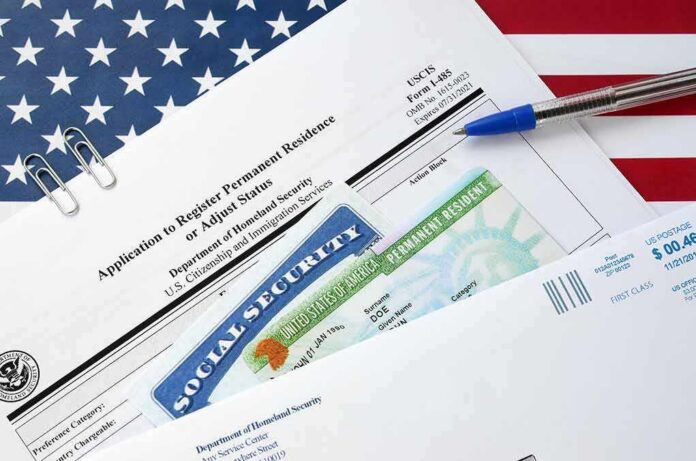
The Department of Homeland Security finalized a new public-charge framework in July 2026 and set an effective date for applications postmarked or e-filed on or after September 18, 2026. The rule applies to both admission and adjustment of status adjudications. It directs officers to make “individualized, fact-specific” determinations based on the totality of the applicant’s circumstances—age, health, family status, assets, resources, financial status, education and skills—while also allowing consideration of whether the applicant has received means-tested public benefits. In practical terms, DHS reversed the 2022 approach that had narrowed the analysis to cash assistance and long-term institutionalization and instead reopened the aperture to the broader universe of income-based programs.
This reversion matters procedurally and substantively. Procedurally, it resets filing strategies: revised forms, evidence of self-sufficiency, and documentation of any benefit interactions become central to the I-485 package. Substantively, it restores officer discretion to treat benefit receipt as a negative factor within the totality test, without bright-line exclusions for programs like Medicaid or SNAP. That shift is precisely what immigrant advocates and state plaintiffs say will trigger widespread disenrollment from safety-net programs among eligible families—a behavioral response they argue is as predictable as it is damaging to public health systems.
The Lawsuits: Claims, Venue, and What’s at Stake
New York, joined by 21 other states and the District of Columbia, filed suit in the Southern District of New York, challenging the rule under the Administrative Procedure Act and related authorities. The complaint’s thrust: DHS granted officers “unprecedented” discretion, adopted a definition and evidentiary regime that departs from statutory limits, and failed to grapple with foreseeable chilling effects and state fiscal harms. The filing is not a press posture; it is a live docket (identified by legal trade reporting) with immediate stakes because the rule governs any application filed on or after the effective date.
The states’ case leans on two pillars. First, statutory interpretation: Congress supplied a public-charge clause and enumerated factors, but, the plaintiffs argue, did not authorize DHS to convert any means-tested benefit into a quasi-disqualifying marker or to downgrade the weight of affidavits of support without reasoned explanation. Second, administrative law: an agency must consider significant reliance interests and predictable behavioral responses; past litigation and research around the 2019 rule documented measurable disenrollment and coverage losses among eligible children in noncitizen households—a pattern courts are familiar with, not a speculative parade of horribles.
The Government’s Case for Self-Sufficiency
The administration frames the rule as a restoration of a “basic principle” that newcomers should be self-reliant and not dependent on taxpayers. In this telling, the totality standard is not novel but faithful to the statute; broad discretion is the point, enabling case-by-case judgments that separate temporary need from likely long-term dependency. DHS and allied defenders also emphasize that the public-charge ground is an admissibility screen, not a poverty punishment, and that considering a wider set of means-tested benefits better aligns outcomes with fiscal prudence. This is the cleanest articulation of the countervailing view: protect public resources, reaffirm self-sufficiency, and trust individualized adjudication rather than categorical exclusions.
Two facts bolster that defense. The rule does not impose an automatic bar based on benefit use; it nests benefit history among multiple statutory factors. And it speaks the familiar language of totality, which appears in the INA’s public-charge clause and in decades of agency guidance—language courts have treated as capacious but not unlimited. The administration’s vulnerability is not the invocation of self-sufficiency per se; it is whether the expansion to “any means-tested benefit” and the downgrading of countervailing evidence are explained with the rigor the APA demands.
A Short History of a Long Fight
Public charge has swung like a metronome across administrations. In 2019, DHS promulgated a rule that sharply expanded the test to include non-cash benefits, triggering injunctions, appellate skirmishes, and ultimately a rescission when policy changed. The 2022 framework narrowed the analysis to cash assistance and government-funded long-term institutionalization. In 2026, DHS rescinded the 2022 approach and again broadened the inquiry. Courts evaluating these iterations have focused on familiar questions: Did the agency acknowledge and justify departure from prior policy? Did it consider reliance interests and plausible real-world harms, including disenrollment by eligible households? And did it remain within the statutory lane Congress marked in 8 U.S.C. § 1182(a)(4)?
Why this matters to states is straightforward. State Medicaid agencies, public hospitals, and local health departments absorb the downstream effects when families forgo preventive care and rely on emergency rooms, and when coverage churn increases uncompensated care. That is why multistate coalitions surface repeatedly in this litigation cycle and why state AGs characterize the rule as not only an immigration matter but a budget and public health problem with immediate, quantifiable spillovers.
Where the Real Disagreement Lives
Set aside the rhetoric and the dispute condenses to two testable claims. First, does expanding the list of countable benefits and amplifying officer discretion produce measurable, harmful chilling effects among people who are legally eligible for aid—especially U.S.-citizen children in mixed-status families? The best available evidence from the last cycle said yes: studies and agency-facing reports documented notable drops in Medicaid participation in such households during the 2019 rule’s tenure, with estimates of disenrollment in the hundreds of thousands to millions nationally depending on assumptions and geography. That corpus won’t decide the case by itself, but it undercuts the idea that the chilling effect is speculative.
Second, even if such effects occur, does the statute permit DHS to weigh them as policy tradeoffs in pursuit of self-sufficiency, or does it require a tighter fit between the factors Congress enumerated and the evidentiary proxies the agency now invites officers to use? Here, courts tend to police process and reason-giving more than they substitute policy judgment. If DHS can show contemporaneous, reasoned analysis explaining why “any means-tested benefit” is a sound proxy for likely future dependence and how affidavits of support and other countervailing factors will be weighed consistently, it strengthens its hand. If the record reads as conclusory or dismissive of documented harms, the states’ APA claims gain force.
NEW: Maryland Republican Cheryl Riley is calling out Attorney General Anthony Brown and state Democrats after Maryland joined a 22-state lawsuit challenging the Trump administration’s expanded “public charge” rule for green-card applicants.
Riley argues Maryland’s Democratic…
— MDBayNews (@MDBayNews) September 20, 2026
Practical Implications for Applicants and Institutions
For families, the most costly mistakes are panic and silence. The rule does not automatically deny adjustment because a child has Medicaid or a household once received SNAP; it directs officers to weigh facts in context. Disenrolling from health coverage or nutrition assistance without competent legal advice can create bigger problems than it solves—health crises, missed care, or income volatility that weakens the very self-sufficiency case applicants must make. Lawyers will prioritize accurate income reporting, robust documentation of employment and private coverage, and careful explanation of any benefit interactions within the household.
For states and providers, the near-term work is outreach and continuity of care. If past is prologue, call centers, clinics, and school districts will field a surge of questions as families try to reconcile headlines with their circumstances. The durable lesson from the last cycle is that clear, legally accurate guidance—who is subject to public charge, which filings are covered by the effective date, which categories are exempt—blunts the worst of the chilling effect and protects public health while the courts do their job.
Sources:
reuters.com, gwp.law, cnn.com, envoyglobal.com, news.bloomberglaw.com, theguardian.com, mintz.com
© featurednews.com 2026. All rights reserved.