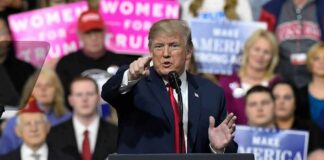
When a sitting senator admits he is “giving it some serious thought” but stops short of any formal move, he is signaling the pre-candidacy phase that defines modern presidential politics: testing the waters without getting wet.
At a Glance
- Sen. Josh Hawley has publicly acknowledged serious consideration of a 2028 presidential bid while denying he has plans or intentions set.
- His remarks are consistent across multiple outlets: contemplation, not a campaign launch.
- The comments follow the 2026 midterms and reflect a broader Republican debate about direction and leadership.
- No evidence of operational steps—committees, staff, fundraising—points to an exploratory posture rather than candidacy.
What Hawley Actually Said—and What It Signifies
On the record and on the same timeline, Sen. Josh Hawley framed a potential 2028 run as genuine deliberation without commitment. In an NBC News interview, he cautioned against the misimpression that he had “plans or intentions,” while conceding he was giving the question “some serious thought” and was “no further along than that.” Multiple local reports reiterated the point, quoting the same language. This is the vernacular of early-stage exploration—real consideration, deliberately hedged, and designed to keep options open without triggering the machinery or legal thresholds of a formal campaign.
Asked separately by the Associated Press about a possible bid, Hawley replied that after the most recent election he, like others who care about the party’s future, had “a lot of thinking to do.” The Hill summarized those AP remarks on the same day as the NBC piece, reinforcing the picture of a senator working through whether there is a meaningful role for him to play in shaping the GOP’s next chapter. Again, the implication is exploratory; there is no suggestion that he has moved into planning or execution.
Testing the Waters vs. Running: The Operational Divide
Seasoned observers look not just to rhetoric but to infrastructure. The hallmarks of a candidacy—committee filings, senior strategists on retainer, targeted travel, donor convenings, message testing at scale—are absent in the public record tied to Hawley’s 2028 prospects. That absence matters because U.S. campaign finance rules and custom draw a bright operational line: once costs and activities cross defined thresholds, a prospective candidate is expected to register and fundraise under candidate rules. Short of that, “testing the waters” allows limited exploration while complying with contribution limits and prohibitions that apply even at the exploratory stage.
Hawley’s own phrasing underscores that distance from formalization. He situates his reflection in the GOP’s post-midterm self-assessment, casting the question as one of “what my part is” rather than “how I launch.” Put plainly, this is the language of role-finding, not barnstorming. It fits the pattern common to ambitious national figures who keep a path open without the commitments that come with official entry—fundraising scrutiny, staffing expectations, and the exposure of early-state performance.
How We Got Here: The Long On-Ramp to Modern Campaigns
American presidential cycles start earlier than they once did, and public signaling like Hawley’s is part of that drift. Scholars date the acceleration to reforms in the 1970s and the professionalization of campaigning in the 1980s and 1990s, which nudged politicians to build name recognition, financial networks, and media presence long before formal announcements. By the 2016 cycle, early attention had become the norm, not the exception, reinforcing a two-step dance: float, explore, then—if conditions ripen—declare.
Exploratory committees were the institutional expression of this reality, codified by campaign finance law and mirrored in media practice. While some modern contenders have blurred or even abandoned the formal exploratory phase, the functional equivalent remains: deliberate in public view, gauge elite and grassroots response, and calibrate the risks. Hawley’s careful articulation—serious thought, no plans—slots neatly into that tradition without obligating him to the next step.
The Tension with Past Denials—and Why It’s Common
In September, Hawley reportedly said he had “no intention” of running in 2028, a categorical formulation that invited comparison when, two months later, he allowed that he was thinking it over. On its face, that is a reversal. In practice, it is a familiar cadence: politicians often use emphatic denials to avoid preempting their current office, punting speculation until a more opportune moment; then, once political conditions or personal calculations shift—here, a midterm outcome and party-wide stocktaking—the language moves from dismissal to contemplation. The newer, on-record statements establish the operative reality: he is weighing it, but he is not running.
For readers attuned to the incentives, the move makes sense. Declaring too early can freeze a senator’s legislative leverage, jolt donor expectations, and make every travel stop a Rorschach test. Keeping the aperture open—especially when one’s party is renegotiating its coalition and message—lets a prospective contender test compatibility between personal brand and national mood without committing resources or ceding flexibility.
What Would Signal a Shift from Exploration to Commitment
Should Hawley decide to move beyond contemplation, the indicators will be concrete. Look first to legal and organizational markers: the creation of a principal campaign committee or an exploratory committee; FEC activity reflecting candidate-caliber fundraising; retention of a finance director, pollster, and early-state operatives; and a travel schedule that privileges Iowa, New Hampshire, South Carolina, and Nevada. In parallel, watch for message codification—policy planks honed into a rationale for running—and for donor summits that function as soft launches. These steps are costly in money and political capital; they also provide tangible proof that a hypothetical has become a plan.
Until those signals appear, the right reading of Hawley’s posture is disciplined optionality. He is inviting stakeholders—colleagues, donors, activists, and media—to imagine him in the conversation without demanding they reorganize around him. That is how modern national aspirations are often cultivated, and it is perfectly compatible with a decision, months from now, not to run at all.
Republican Sen. Josh Hawley mulling a 2028 White House run https://t.co/CmzNarsy4k pic.twitter.com/vruY3aI0B5
— California Post (@californiapost) November 20, 2026
Implications for the Republican Field and the Media Lens
Hawley’s reflection enters a crowded speculative lane. In cycles when a party looks beyond the incumbent era or toward succession, many figures float; most never launch. For the GOP, the next phase will be shaped by how would-be contenders interpret the 2026 returns, the governing climate, and the internal debate over tone and policy. Hawley’s brand—combining populist-inflected themes with institutional combativeness—has a constituency, but his statements do not yet seek to define the field; they seek to see if there is a lane for him within it. That distinction is easy to lose in horse-race coverage that compresses “considering” into “running,” but the underlying evidence here is narrower, and clearer.
Bottom Line
The facts are straightforward. Sen. Josh Hawley is openly contemplating a 2028 presidential bid. He says he has no plans or intentions at present. Independent outlets captured the same, limited status: exploratory thinking prompted by post-midterm reflection, not an organized campaign. Absent filings, staffing, or fundraising that would indicate escalation, the story is where he left it—serious thought, held at arm’s length from commitment.
Sources:
nypost.com, piqmarkets.com, wisevoter.com, politicalwire.com, ky3.com, theatlantic.com, mcdonoughvoice.com, journalistsresource.org, spectrumlocalnews.com, gwlr.org, boston.com
© featurednews.com 2026. All rights reserved.