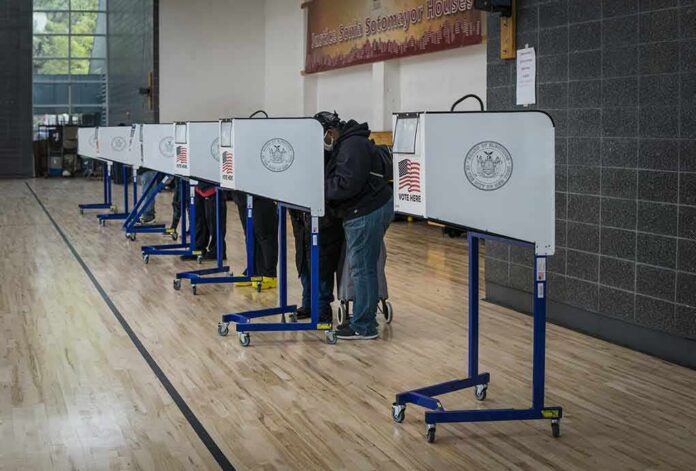
Emergency election orders are not endorsements of policy; they are about timing and stability, and in New Hampshire’s student ID fight the Supreme Court used that tool to freeze rules in place for November while the merits continue to be argued.
The Short Version
- HB 323 removed student IDs from New Hampshire’s list of qualifying photo IDs to obtain a ballot; the dispute then narrowed to what evidence voters without such ID may use under a statutory “safety valve.”
- A federal judge read that safety valve to allow student IDs as corroborating evidence; the Secretary of State’s guidance discouraged their use altogether.
- Invoking the Purcell principle, the Supreme Court stayed the judge’s order before the election, restoring the state’s stricter guidance for November only, over Justice Ketanji Brown Jackson’s dissent.
- The record shows scant empirical evidence that student IDs cause fraud, and the long-run legality of a categorical bar remains unresolved.
What the Court Did — And What It Didn’t
The Supreme Court’s unsigned order stayed a lower-court injunction that had required New Hampshire to permit consideration of student IDs under its fallback identification process. A stay is emergency relief, not a final ruling: it restores the pre-injunction status to minimize late-stage disruption and allows the underlying appeal to proceed. The state argued that revising poll-worker training and voter-facing materials weeks before voting would sow confusion—precisely the election-management harm the Court has cautioned against in Purcell v. Gonzalez. The stay thus temporarily reinstated the Secretary of State’s stricter guidance for the November election only. Justice Ketanji Brown Jackson dissented.
That posture matters. The order signaled nothing conclusive about whether the statute, as implemented, is lawful; it simply controlled what rules would govern in the compressed run-up to voting. Readers should resist the common mistake of treating emergency election stays as merits decisions.
How New Hampshire’s Rule Works
HB 323 changed two things that are easy to conflate. First, it removed student identification cards from the enumerated list of “qualifying” photo IDs a voter may present at the check-in table to obtain a ballot. Second, it left in place a separate, long-standing safety-valve procedure for people who arrive without a qualifying ID and can still satisfy officials of their identity by other reasonable means. The statutory fight turned on whether a student ID could be one fact among several under that safety valve, even though it no longer sufficed on its own.
The Secretary of State issued implementation guidance instructing poll workers that student IDs were not acceptable identification and directed students to use a driver’s license from any state, a passport, a military ID, or to rely on other avenues for establishing identity and residence—such as utility bills or bank statements—to satisfy distinct registration and domicile requirements. The guidance drew a bright line; the district court later read the statute to require a more flexible approach at the safety-valve stage.
The Lower Court’s Rebalance — And the Purcell Turn
After summer litigation, the district court concluded in early October that while student IDs could not be used as stand-alone qualifying IDs, nothing in the statute barred officials from considering them as corroboration when a voter lacked a qualifying ID. The court therefore enjoined the Secretary’s directive to the extent it categorically prohibited or discouraged poll workers from considering student IDs under the safety-valve process and ordered revised guidance. Days later, the state sought Supreme Court intervention, arguing the injunction came too close to the election and would destabilize training, signage, and voter expectations. The Supreme Court issued a stay, restoring the stricter guidance for November while the First Circuit appeal proceeded.
The state’s application leaned on election-administration timing rather than new empirical security evidence about student IDs. That is consistent with Purcell’s focus: federal courts should be cautious about changing election rules late in the day because even well-intentioned corrections can yield real-world confusion.
Security, Access, and What the Record Actually Shows
On the security side, the state’s case rests on legal distinctions: student IDs are institution-issued credentials that do not reflect citizenship status and vary in issuance rigor, whereas driver’s licenses and passports are standardized government IDs. But the litigation record, as reported, does not surface concrete fraud incidents or data tying student IDs to impersonation or eligibility breaches in New Hampshire. The justification is chiefly categorical and administrative, not empirical.
On the access side, student advocates emphasize that students had long used familiar campus IDs; removing them increases friction and risks deterring eligible voters who lack passports or in-state licenses. The Secretary’s guidance lists alternatives, but the record offers no statewide data on how many affected students actually possess those documents, what it costs to obtain them on the relevant timeline, or how many will instead be pushed into the safety-valve process. That is where real measurement—not rhetoric—would elevate the debate.
Where the Real Disagreement Lies
There are three separable questions in voter-ID policy. May a state require identification at the polls? Which documents are sufficiently reliable to be qualifying IDs? And what counts as a meaningful fallback for those without them? The Supreme Court has acknowledged states’ interests in election integrity and the permissibility of photo ID regimes in principle. The New Hampshire controversy concentrates on questions two and three: whether student IDs are categorically too weak as credentials and, even if so, whether officials may weigh them as corroborating facts under the safety valve. The district court answered the latter yes; the Secretary’s guidance effectively answered no. The Supreme Court’s stay prevents that conflict from changing field practice during the election, but it does not resolve the underlying statutory or constitutional issues.
Zooming out, national research on voter-ID laws is mixed on turnout effects, with high-quality studies finding little average impact on participation and no clear reductions in fraud—a reminder that the fiercest political fights often occur over rules whose measurable effects are small and context-dependent. That is not a reason to ignore design details; it is a reason to test them, document trade-offs, and calibrate rules to local conditions.
Supreme Court clears NH student ID ban
Justices stay order allowing student IDs for Nov. 3 vote over Jackson dissent
New Hampshire voters need government photo ID at the polls#SCOTUS #Midterms #Voting
— Newsaholic (@MrNewsaholic) October 23, 2026
What To Watch Next
The merits appeal will have to answer two practical questions with legal consequences. First, does New Hampshire’s safety-valve language permit officials to consider student IDs as one piece of “evidence reasonably establishing” identity when a voter lacks a qualifying ID? The district court said yes, and that interpretive holding remains untested on appeal. Second, even if the statute allows that flexibility, may the state, by guidance, foreclose it without contravening either the statute or federal constitutional guarantees against undue burdens or age-based discrimination? Those are merits questions, not timing questions.
The responsible path forward is empirical. If lawmakers believe student IDs are insecure, the record should show how—issuance protocols, photo standards, expiration control—and compare that with accepted IDs. If administrators fear confusion, they should quantify it—training time, help-desk volume, observed error rates. And if advocates fear disenfranchisement, they should demonstrate how many students lack alternatives on realistic timelines, not merely assert inconvenience. Courts are most persuasive when judging rules against a record that moves beyond slogans.
Sources:
cbsnews.com, nhd.uscourts.gov, scotusblog.com, cnn.com, nbcboston.com, nhpr.org, vox.com, repository.belmont.edu
© featurednews.com 2026. All rights reserved.