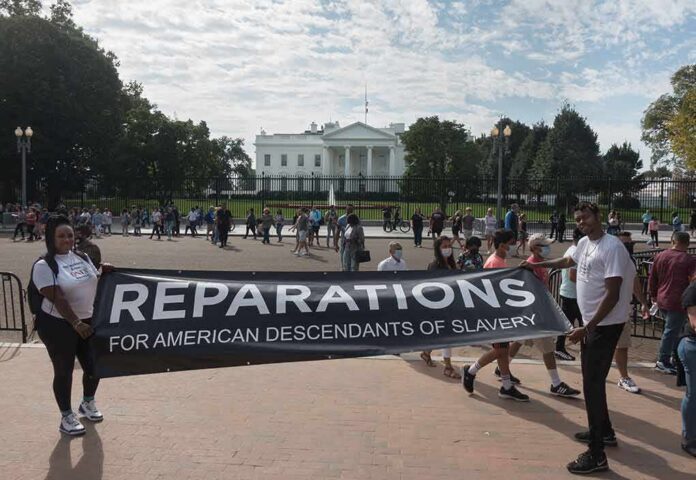
The core fight in American reparations policy is not whether harm occurred, but how to define the beneficiary class in a way that is morally coherent, administratively workable, and legally durable; on that question, the evidence shows lineage-based eligibility has become the dominant, testable design, while a competing “big tent” model seeks to repair broader, post-Emancipation racial harms.
The Short Version
- Two models anchor today’s reparations design debate: lineage to U.S. slavery versus expansive identity/harm definitions that include all Black people affected by American racism.
- Lineage frameworks concentrate remedies on descendants of those enslaved in the United States and are argued to be clearer to verify and more likely to withstand constitutional scrutiny.
- Inclusive frameworks, championed by advocacy coalitions, prioritize repairing the full arc of racially exclusionary policies after Emancipation, including harms to Black immigrants.
- California’s task force process and allied scholarship have crystallized the trade-offs, including hybrid “tiered” approaches that combine descendant benefits with broader or universal measures.
What the eligibility fight is actually about
Designing reparations is a boundary-setting exercise. Once a legislature accepts that slavery and its legal descendants produced quantifiable, state-mediated harm, the next problem is definitional: who, exactly, is the rights-bearing class the remedy is intended to reach, and how will an agency confirm membership in that class? In the United States, the focal split is between a lineage standard—restricting eligibility to people who can document descent from at least one person enslaved in the U.S.—and inclusive standards that tie eligibility to racial identity, residence, and exposure to discriminatory American policy after Emancipation. Each approach encodes a distinct theory of the injury, the state’s duty, and the administrative proof a claimant must bring to the counter.
Over the last several years, task force debates, academic syntheses, and advocacy briefs have converged on the clarity of lineage as one workable answer. California’s deliberations surface this most explicitly; researchers describe a first-tier descendant class and, in some proposals, additional tiers for Black residents more broadly and for universal remedies that address shared harms or public goods. The attraction is intelligibility: lineage can be adjudicated with genealogical evidence and standardized criteria, giving a program clearer guardrails and presumptively stronger constitutional posture than an open-ended racial category.
The lineage case: a compensatory remedy for a specific, traceable wrong
Lineage proponents—ranging from academic architects of modern frameworks to grassroots organizations—argue that reparations compensate a discrete, state-recognized property and citizenship injury borne by a defined class: people enslaved in the United States and their descendants. In the contemporary literature, the standard is spare by design: one ancestor enslaved in the U.S., paired in some versions with a prior record of self-identification as Black or African American to avoid opportunistic claims. The U.S. Freedmen Project and allied descendant-centered groups embrace this boundary both on first principles and as a constitutional survival strategy: if the government pays compensation, it must be able to demonstrate a tight fit between the remedy and the class directly harmed by state action, which lineage better provides than a race-only proxy.
California’s process captured the practical upsides. A lineage rule permits program designers to build documentation trees, standardized evidentiary checklists, and adjudication timelines—the unglamorous mechanics that keep a benefit program from collapsing under ambiguity. Scholarship summarizing the national field now treats “lineage standard” and “identity standard” as distinct building blocks; the former is the core eligibility gate in many serious proposals, the latter a supplementary screen to corroborate social membership and continuity over time.
The inclusive counterproposal: repair the full arc of state-mediated racial subordination
On the other side, national advocacy coalitions advance an expansive theory: American governments inflicted cognizable harms not only during slavery, but also through Jim Crow, redlining, exclusion from public benefits, and discriminatory law enforcement that reached all Black communities in the United States, including immigrants who arrived after 1865. From that vantage, limiting eligibility to descendants of U.S. slavery misidentifies the harm and withholds redress from people injured by the same state actors enforcing the same caste logic after slavery’s formal end. The National African American Reparations Commission (NAARC) states the position plainly—repair should extend to “all Black people harmed by America in America,” explicitly including newly arrived immigrants subject to racially exclusionary policies.
Scholarly summaries capture how this view operationalizes eligibility: either a race/identity screen (for example, long-standing self-identification as Black on official records), or a hybrid model that pairs a descendant tier with benefits available to all Black residents and a third tier of universal policies such as investments in schools, health, or housing that redound to everyone. The inclusive camp’s moral claim is straightforward: the state’s duty extends to all those it injured through racially targeted laws, regardless of whether their ancestors were enslaved within U.S. borders.
California as a design laboratory: lineage leads, hybrids emerge
California’s task force made the conflict legible. Researchers documenting the process report that the central question was whether the experience of Black immigrants and their descendants differed enough from that of U.S.-enslaved descendants to justify exclusion. The state ultimately adopted a lineage-based definition for direct compensation while leaving room for broader policy reforms, a move that has since informed other jurisdictions considering similar boundaries. The “three-tier” structure discussed in the literature is not a rhetorical flourish; it is an admission that programs can pursue two aims at once—compensation to a legally defined victim class and investment to unwind ongoing structural inequities—with different eligibility rules matched to each aim.
That clarity matters beyond politics. Eligibility tests that collapse compensation and general anti-poverty or anti-discrimination goals into a single race-based gate invite equal-protection challenges. By contrast, a lineage gate for compensatory payments, flanked by race-neutral or broadly targeted public investments, gives courts a tighter fit between means and ends, and administrators a cleaner file to audit.
Administrative proof and constitutional fit
A workable program must survive two tests: can claimants prove membership without prohibitive burden, and can the government defend the line it drew as substantially related to the harm it seeks to remedy? The contemporary research consensus treats lineage as a verifiable criterion—genealogy anchored in records, corroborated by historical datasets—supplemented, where used, by time-stamped self-identification to close loopholes. California’s record, together with comparative syntheses, shows why lineage is attractive to drafters: it narrows discretion, aligns the remedy with the original takings and citizenship exclusions, and reduces the risk that a court will view the program as an impermissible race set-aside rather than a narrowly tailored compensatory measure.
Inclusive proposals answer the first test but struggle more on the second. They can readily define contemporary harms and affected populations; they are less able to tie a direct compensation check to a specific, inheritable, legally recognized injury for each claimant. That is one reason the tiered approach—descendant compensation plus broader reforms—has traction in both scholarship and state practice.
Federal Reparations vs Black American Homeland Recompense Laws
The debate surrounding redress for Foundational Black /Antebellum-Black / Anglo-Black / Anglo-Moor Americans, frequently centers on federal action. However,
Frederick Delk advocates for a compelling alternative… pic.twitter.com/f1i679kwqO— BlackAmericanHomeland (@FrederickDelk) September 30, 2026
What this means for policy designers now
For jurisdictions intent on compensatory payments, the evidentiary and legal record points to a lineage-first framework with clearly drafted documentation standards. For governments that also want to address the ongoing effects of racially exclusionary policy on all Black residents, the tractable path is to separate instruments: preserve a narrow compensatory tier for descendants of U.S. slavery and deploy broader, race-neutral or widely accessible investments for structural repair. California’s experience and the academic mapping of eligibility models are not a script, but they are a usable template: define the injury, match the beneficiary class to that injury, and use other policy tools—civil rights enforcement, fair housing, small-business capital, school finance—to address the rest.
Sources:
foxnews.com, cambridge.org, oag.ca.gov
© featurednews.com 2026. All rights reserved.