The hard question is not whether unauthorized national‑security leaks can be dangerous; it is whether collapsing every kind of disclosure into “shootable” treachery strengthens U.S. security or erodes the constitutional and operational systems that actually keep it safe.
At a Glance
- President Trump publicly argued that “leakers should be shot,” framing the stance as a deterrent against disclosures that imperil military operations.
- His example centered on a claimed leak of attack timing that allegedly forced a two‑day delay in an Iran‑related operation; that causal link has not been independently substantiated.
- The U.S. has long prosecuted leaks primarily under the Espionage Act; executions for peacetime espionage are extraordinarily rare and statutorily narrow.
- Press‑freedom and whistleblower advocates warn that equating all leaks with treason chills lawful reporting and silences disclosures of official wrongdoing.
What was said, and why it matters
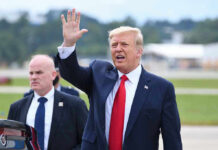
At an Arizona rally, President Trump stated bluntly: “In my opinion, leakers should be shot,” justifying the call by invoking the most acute form of operational risk—disclosure of attack timing and troop movement. He described a source divulging a departure time from Missouri and asserted the leak compelled a two‑day delay in a planned U.S. strike against Iranian targets, presenting execution as a deterrent commensurate with the stakes of modern warfare. The crowd cheered, a reminder that the promise of ironclad secrecy has political potency in a security‑first frame. The episode is not a policy paper; it is a maximalist claim that turns on two questions: what counts as a “leak,” and what penalties, in law and in practice, attach to each category of conduct.
The granular allegations—the identity of the purported source, whether the disclosure met statutory elements for unlawful release of classified information, and whether the delay and risk increase were caused by that leak—remain uncorroborated in public records. The gist, however, is clear: Trump is collapsing a spectrum of conduct into a single bucket and demanding the harshest sanction. The security logic is simple and severe; the legal landscape is not.
How U.S. law actually treats leaks and espionage
American leak prosecutions travel, mostly, through the Espionage Act of 1917 and adjacent national‑security statutes. Historically, the government distinguished between classic espionage—funneling state secrets to a foreign power—and “leaks to the press,” which were comparatively rare targets of criminal cases for most of the twentieth century. That pattern shifted in the modern era. Before 2009, academic tallies count only a handful of prosecutions aimed at press‑related disclosures; post‑2009, cases involving media‑implicating leaks rose sharply, reflecting a digital era in which classified archives can be copied and transmitted at scale.
Capital punishment lives at the far edge of this framework. Peacetime executions for espionage are vanishingly rare in U.S. history—the Rosenbergs in 1953 are the canonical example—and contemporary federal law authorizes the death penalty only in narrow circumstances, typically where an intelligence disclosure foreseeably results in death (for example, outing a covert agent whose subsequent killing is causally linked to the offense). Even then, prosecution must meet exacting statutory elements and constitutional safeguards; there is no general “execute leakers” authority in the code.
Where rhetoric outruns the rule of law
Trump’s call does not differentiate among at least five distinct behaviors: classic espionage for a foreign service; willful unauthorized disclosure to journalists; negligent mishandling of classified material; whistleblowing through lawful channels; and editorial publication by news outlets. The law does. Each carries different elements, defenses, and penalties. Executing “leakers,” as a category, would require either radical statutory overhaul or an unconstitutional gloss that collapses mental state, harm, and venue into a single, punitive remedy—a move courts would not sustain and agencies would be hard‑pressed to implement.
Even on the national‑security merits, the deterrence case is asserted, not demonstrated. There is no public, empirical evidence that capital punishment decreases press‑related unauthorized disclosures, which are often driven by motives—exposure of perceived wrongdoing, bureaucratic rivalry, or misjudgment—that are not sensitive to marginal sentence increases. By contrast, enforcement certainty, disciplined need‑to‑know controls, timely classification reviews, insider‑threat monitoring, and compartmentalization demonstrably reduce operational risk without conflating whistleblowing with espionage.
The unresolved operational claim
Trump’s most serious contention is not the punishment, but the predicate: that a well‑timed leak compromised a sensitive strike and forced a two‑day delay. If true, that is operational malpractice with real‑world risk. However, the public record as of this writing contains neither a declassified after‑action report nor corroborating Pentagon timeline tying a delay causally to a leak; the assertion rests on the president’s account and secondary reporting that paraphrases it. Absent names, charging instruments, or an adjudicated record, the claim is a cautionary scenario, not an established case study. The scenario is plausible, which is precisely why commanders already treat timing and movement as among the most tightly held operational details. Plausibility, however, is not proof.
The press, whistleblowers, and the constitutional line
The First Amendment does not immunize the theft of secrets, but it does protect robust reporting and the public’s right to receive information. Press‑freedom advocates warn that bundling “reporters” with “leakers,” as Trump did rhetorically, risks chilling lawful journalism and discouraging insiders from using authorized reporting channels or inspectors general to surface wrongdoing. That chill is not hypothetical; experts have flagged leak‑probe tactics—especially sweeping subpoenas or source‑hunting dragnets—as pressure points where national‑security imperatives can run afoul of constitutional protections unless narrowly tailored and used sparingly.
There is a workable boundary. Agencies can and should criminally pursue willful, harmful disclosures of properly classified operational details, particularly those that expose human sources or compromise active operations. Simultaneously, they can preserve protected spaces for lawful whistleblowing and ensure that investigative tools aimed at reporters clear a high, necessity‑based threshold. That balance has always been fragile; absolutist slogans on either side make it more so.
Policy that would actually harden operational security
Set aside the firing squad imagery and focus on measures with a proven record. First, tighten access by function, not grade: classification and compartmentalization should follow mission need, with continuous evaluation of who actually requires time‑sensitive operational data. Second, pair insider‑threat analytics with rigorous privacy guardrails; anomalous access and exfiltration patterns are detectable, and well‑governed monitoring deters and catches high‑risk behavior without criminalizing routine work. Third, speed declassification reviews for historical and policy materials so that fewer officials feel compelled to launder policy disputes through unauthorized disclosures. Fourth, refine damage‑based charging decisions; when the government can show concrete, foreseeable harm from a willful disclosure, penalties should be stiff—within the current statutory architecture—while reserving the heaviest tools for the narrow band of cases that meet the law’s lethal‑consequence thresholds.
The bottom line
Trump’s core grievance—that leaking operational details can endanger missions and lives—is real, and it resonates. But the prescription he offered from the podium bears little resemblance to the legal and operational systems the United States actually uses to safeguard secrets. Executions for “leakers” as a class are neither authorized nor prudent. The durable path is harder and less theatrical: sharpen the elements of harm, raise the certainty of proportionate enforcement, fortify access controls, and protect the constitutional architecture—journalism and lawful whistleblowing included—that prevents secrecy from curdling into impunity. That is how a serious government deters the leaks that matter most.
Sources:
azcentral.com, washingtonexaminer.com, yahoo.com, galvnews.com, article.wn.com, scoop.co.nz, truthout.org, abcnews.com
© featurednews.com 2026. All rights reserved.