When a politician dismisses an unflattering poll by pointing to the size of his rally crowds, he is making a rhetorical move with a long pedigree — and a well-documented flaw: crowd enthusiasm is not a sampled, weighted measurement of public opinion, and the two have diverged sharply and often in American political history.
Key Points
- President Trump told CNN’s Kristen Holmes her network’s Latino approval numbers were “fake,” but the 27% figure she cited actually came from an NBC News/Telemundo survey, not a CNN poll.
- That 27% approval figure is not an outlier — it has been independently confirmed by Fox News, The Hill, Newsweek, Politico, USA Today, and Axios, all reporting on the same underlying NBC/Telemundo data.
- Trump’s 2024 Latino vote share — roughly 45-46%, a modern Republican high — gives his rejection of the current numbers some narrative cover, but it describes a past election, not current approval.
- Separate polls from the Texas Politics Project, Pew Research, and Cook Political Report/TelevisaUnivision show the same directional decline, undercutting the claim that one pollster is uniquely biased.
- Rally crowd size is a poor substitute for survey data because it says nothing about the demographic composition or representativeness of attendees.
What Actually Happened at the White House
On October 5, 2026, CNN senior White House correspondent Kristen Holmes pressed Trump on polling showing his approval among Latino voters at 27%. His reply was unambiguous: “Oh, I’m doing great… You’re fake news… My poll numbers are great, and all you have to do is look at the crowds we’re drawing… No, CNN poll numbers are fake, and your whole outfit is fake, and so are you.” The exchange was widely clipped and shared, and it fit a familiar pattern for a president who has spent a decade attacking mainstream outlets as biased whenever they report numbers he dislikes.
There is a genuine factual wrinkle worth isolating from the theater of the moment. The 27% figure Holmes raised did not originate with CNN. It came from a national NBC News/Telemundo survey of 800 registered Latino voters, conducted in English and Spanish from September 21 to 28, 2026, using a mix of live telephone interviews and online response. CNN reported on that poll — as did The Hill, Newsweek, Fox News, Politico, USA Today, and Axios — but did not commission it. Attacking “CNN’s” Latino polling, strictly speaking, targets the wrong institution. That distinction matters for precision, but it does not rescue the substantive claim that the underlying number is fabricated, because the same figure recurs across outlets with no institutional overlap or shared incentive to inflate Democratic prospects.
A Real Shift, Not a Fixed Floor
Trump’s defenders have a legitimate data point to lean on, and it predates this controversy by years. CNN’s own 2024 exit polling found Trump won roughly 45% of the national Latino vote, the strongest showing for a Republican presidential nominee in the exit-poll era, narrowing a 38-point deficit in 2016 and a 33-point deficit in 2020 down to just 5 points. Latino men, in particular, broke toward him for the first time that cycle, with CNN’s exit poll putting his support among that group at 54%. That history is not in dispute, and it explains why the “fake polls” framing lands with some supporters: it conflicts with a real and recent electoral gain, not an imagined one.
But a win in November 2024 describes a moment of maximum goodwill, not a permanent condition. Approval and vote choice are different measurements taken at different times, and the evidence from late 2026 shows the goodwill eroding substantially. The NBC/Telemundo poll found 69% of Latino respondents disapproving of Trump’s job performance against 27% approving, with only 20% approving of his handling of the cost of living and 30% on immigration — even as two-thirds said his administration had gone too far on enforcement. Latino men specifically, the subgroup that delivered his 2024 gains, registered 33% approval against 64% disapproval, according to Newsweek’s reporting on the same survey.
Convergence Across Pollsters Undercuts the “Fake” Claim
A single poll can be dismissed as an outlier, a bad sample, or a partisan artifact. A pattern repeated across unrelated organizations is harder to wave away. A Texas Politics Project/University of Texas survey found Latino voters in that state had moved from an even 48% split on Trump in October 2024 to 51% unfavorable and just 41% favorable by late September 2026. A separate Cook Political Report/TelevisaUnivision survey found 18% of Latino voters who backed Trump in 2024 now disapprove of his performance. Pew Research’s pre-election work in 2024 had already shown the race among Latinos closer than Trump’s eventual result, suggesting his coalition was softer than the exit-poll topline implied even at its peak. None of these organizations share a newsroom, an owner, or an obvious incentive to coordinate a false narrative, which is precisely why their alignment on direction — down, and down sharply among men and working-class voters — carries more evidentiary weight than any single survey standing alone.
Trump clashes with a reporter over polls showing his approval among Latino voters has declined.
Trump dismissed the premise, saying his poll numbers are “great”, before accusing the reporter of being “fake news” and associated with CNN.#DonaldTrump #Trump #USPolitics… pic.twitter.com/O86iOki2tQ
— CNBC-TV18 (@CNBCTV18News) October 6, 2026
Why Crowd Size Fails as a Counter-Metric
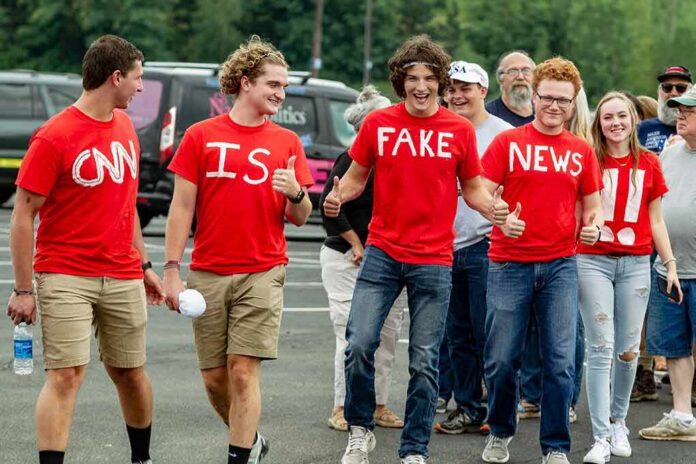
Trump’s alternative evidence — “look at the crowds we’re drawing” — is not a trivial argument, but it is a categorically weaker one. A rally audience is self-selected by enthusiasm, proximity, and free time; it is not drawn or weighted to resemble the electorate, let alone a specific ethnic subgroup within it. No data in the public record demonstrates that recent rally crowds were disproportionately Latino or that their composition tracks national sentiment. Scientific polling, whatever its imperfections — mode effects, likely-voter screens, sampling error — is explicitly built to estimate a defined population; crowd size is not built to do that at all. Treating the two as comparable evidence inverts a basic distinction between anecdote and measurement that any analyst, regardless of party, would recognize.
What It Means Going Forward
The practical stakes extend past Latino approval to the midterms themselves. CNN’s Harry Enten has tracked the decline alongside falling support among independents, suburban voters, and non-college whites, and has connected it directly to competitive races such as the Texas Senate contest, where Democratic nominee James Talarico has closed sharply against Republican Ken Paxton partly on the strength of eroding Latino support in a state Trump carried comfortably in 2024. Dismissing unfavorable polling as “fake” may serve a short-term communications purpose, but it does nothing to arrest a trend that is now visible across half a dozen independent measurement instruments — and candidates on the ballot in 2026 will be judged by votes, not rally photographs.
Sources:
thegatewaypundit.com, cnn.com, mediaite.com, ssrs.com, newsweek.com
© featurednews.com 2026. All rights reserved.