When unidentified graves surface in the Mojave fringe, the crucial early truths tend to be simple and spare: who was found, where, and how officials know it—while nearly everything else that matters to families and investigators alike must wait on methodical forensic work. That is exactly the shape of the Lancaster case.
At a Glance
- Los Angeles County Sheriff’s investigators identified two men—Ricky Phillips, 61, and Edward Perez, 46—found in shallow graves on a remote Lancaster-area desert property.
- The discovery emerged from missing-person investigations; detectives have not released cause of death or suspect information.
- Medical examiners routinely defer cause and manner of death while toxicology and other studies run; weeks to months is a normal interval.
- Southern California deserts have a long history of shallow-grave recoveries linked to homicides and unresolved disappearances, shaping how agencies investigate and pace public information.
What Authorities Have Confirmed So Far
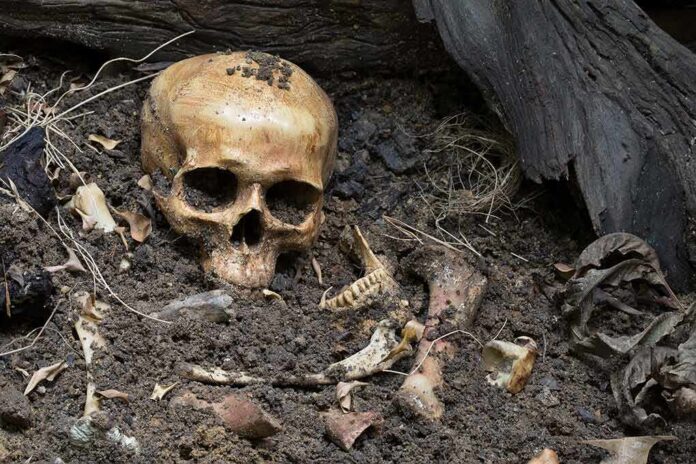
Detectives with the Los Angeles County Sheriff’s Department located two bodies in shallow graves on a remote parcel near Lancaster during an investigation into recent missing-person cases. The remains were identified as those of Ricky Phillips, 61, and Edward Perez, 46—both local men reported missing weeks earlier. Officials publicly released the identifications and the basic discovery context but have not disclosed the cause or manner of death, nor have they named suspects or persons of interest. These early disclosures align with standard major-case practice: confirm identity and jurisdiction; hold back specifics that could compromise interviews, searches, and forensic comparisons.
The Gravesite Recovery Unit and homicide detectives manage such scenes with a layered approach—surface documentation, controlled excavation, and evidence mapping—because shallow burials often contain trace materials (fibers, tool marks, tire impressions) that can drive later lab work. That posture explains why public releases emphasize identification over narrative in the first week, and why even obvious-seeming conclusions about violence are not formalized until the medical examiner has the evidence to support them in court, not just in the press.
Why Cause and Manner of Death Are Often “Deferred”
In California, suspected homicides, unexplained deaths, and sudden unexpected deaths move through a forensic death-investigation pathway designed to privilege accuracy over speed. If the cause of death cannot be determined within statutory timelines, death certificates are filed with “cause deferred,” unlocking disposition permissions while laboratory and investigative work continues. The Los Angeles County Medical Examiner describes “deferred” as pending additional inquiry—a status that can last several weeks to months as toxicology, histology (tissue analysis), and specialized studies return. That delay is not hedging; it is the standard of practice.
Two practical realities drive this cadence. First, decomposition in arid desert conditions can obscure trauma, requiring radiology, skeletal analysis, and scene-to-autopsy correlation to distinguish perimortem injury from postmortem change. Second, manner of death—homicide, accident, suicide, natural, undetermined—depends not only on medical findings but on circumstances established by law enforcement; those streams of evidence must be reconciled before a determination is signed.
The Desert Pattern: Why This Setting Commands Caution
Southern California’s deserts have, for decades, produced some of the state’s most consequential recoveries tied to missing-person investigations. The McStay family case—four bodies located in shallow graves near Victorville in 2013—illustrates the arc: sparse scene details at recovery, complex lab work, and ultimately a conviction on a largely circumstantial case built from financial records, cell-site data, and limited physical evidence. The lesson investigators took from cases like McStay’s is procedural, not cinematic: keep the early record tight, avoid contaminating witness memory, and let lab timelines govern public specificity.
Older recoveries, from Inyo County’s 1988 shallow-grave identifications to Mojave Desert cases resolved decades later through DNA, reinforce two points. First, desert taphonomy—the science of how bodies change after death—can both preserve and frustrate: aridity slows some decay while scavengers and heat accelerate others. Second, identification and attribution capacity have improved markedly; today’s labs can extract probative signals from evidence that would have been functionally silent in earlier eras. That progress argues for patience in the present tense, because the tests worth waiting for are now often decisive.
What Investigators Are Likely Doing Next
With identities confirmed, the case pivots to reconstruction. Expect parallel workstreams: scene analysis (soil stratigraphy, burial depth, potential tool or tire impressions), autopsy and post-autopsy lab studies (toxicology, microscopic tissue review, imaging), and a full victimology. Victimology is the disciplined accounting of a person’s recent movements, relationships, financials, communications, and stressors; in practice it means pulling cell-site location records with warrants, subpoenaing bank and app data, and cross-walking license-plate reader hits. Because this discovery was linked to open missing-persons reports, detectives will already have early timelines and contact networks mapped—a head start that often proves decisive in the first month.
At the same time, detectives will preserve investigative advantage by controlling publicly released details: clothing, bindings, items found in fill layers, or specific trauma signatures. That discretion is not opacity; it is a tool to evaluate tip quality and to minimize the risk that non-public facts leak to potential suspects who might alter behavior, destroy evidence, or align alibis.
How Families Can Expect the Timeline to Unfold
Families and communities, understandably, want the why and the who immediately after the who it is becomes public. The discipline of this system rarely accommodates that emotional timeline. Toxicology in many jurisdictions returns in roughly two to four months; if skeletal analysis or specialized testing is indicated, expect longer. Meanwhile, detectives may conduct dozens of interviews whose value depends on the integrity of non-public details. Those interviews, plus digital forensics and financial analysis, typically determine when—and whether—an arrest is appropriate. The point is not delay for its own sake, but a bias for durable answers over quick ones.
Why Early Comparisons to Other Desert Cases Can Mislead
It is tempting to read every desert shallow grave through the lens of the last headline case. That is a diagnostic trap. The similarities end at the burial method and geography; motive structures and offender profiles diverge widely across organized crime disputes, intimate-partner violence, financial coercion, and opportunistic predation. The responsible frame is modest: let the specific evidence in this case—transport signatures at the scene, communications timelines, and social graphs tied to Phillips and Perez—determine which comparative patterns, if any, actually apply.
Missing men found dead in shallow graves in California desert as mystery grows https://t.co/0wNHtslkxP pic.twitter.com/V9JDveC5w8
— California Post (@californiapost) October 3, 2026
What We Know, What We Don’t, and What That Means
We know two Lancaster-area men—Ricky Phillips and Edward Perez—were located in shallow graves on a remote desert property and identified by the Los Angeles County Sheriff’s Department. We know the discovery emerged from missing-person inquiries and that investigators have not released cause or manner of death, suspect names, or a theory of the crime. Those omissions are not defects in the record; they are hallmarks of a major-case investigation being built for endurance in court. The next material disclosures are likely to come from the medical examiner’s determinations and, if the evidence supports it, from arrests rooted in corroborated timelines rather than speculation.
Sources:
nypost.com, latimes.com, rollingout.com, missingpersons.icrc.org, charleyproject.org, calgary.citynews.ca, abc15.com, independent.co.uk, yahoo.com, abcnews.com
© featurednews.com 2026. All rights reserved.