When a cockpit becomes a crime scene at 38,000 feet, the question of who is ultimately responsible almost always outruns the evidence — and in the case of Flydubai Flight FZ1073, a sitting American president answered that question publicly before his own intelligence services, or the Israeli government, were willing to.
Key Points
- A Flydubai flight from Dubai to Tel Aviv was diverted after its co-pilot stabbed the captain and attempted to seize control of the aircraft, carrying roughly 150 Israeli passengers at the time
- President Trump told reporters he believed Iran was linked to the co-pilot, saying “the answer, based on what I’m hearing, is yes, but we’re working on it right now”
- Israeli Prime Minister Benjamin Netanyahu and Foreign Minister Gideon Saar both said it was too early to attribute the attack to Iran, with Saar stating there was “no proof of Iran link yet”
- The UAE opened a formal prosecutorial investigation into whether the attack involved terrorist activity or prior planning, without naming Iran as a target of that inquiry
- The co-pilot, reported to be an Omani citizen, remains the subject of an active, multi-country investigation whose findings on motive have not been completed
What Happened Aboard Flight FZ1073
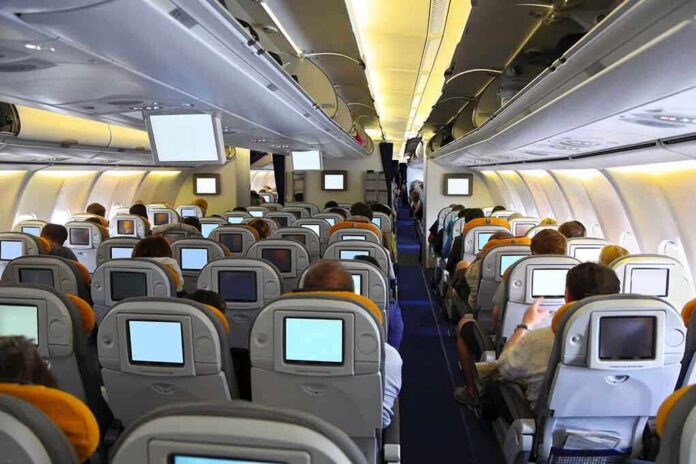
The facts of the incident itself are not in dispute. Flydubai Flight FZ1073, en route from Dubai to Tel Aviv, was thrown into crisis when its co-pilot stabbed the captain in the cockpit and attempted to force the aircraft off course, according to Reuters and multiple outlets covering the diversion. The captain, reported in subsequent coverage to be Indian, fought back and regained control, and the plane was diverted and landed safely in Saudi Arabia rather than continuing to Tel Aviv. The co-pilot was taken into custody by Saudi authorities, who began coordinating with the UAE and other governments to determine what had driven him to act. The passengers, who Israeli officials said numbered roughly 150 and were largely Israeli nationals, were eventually moved onward toward Israel, giving the incident instant resonance in a region already primed to read any attack on an Israel-bound flight through the lens of state-sponsored terrorism.
Trump’s Iran Claim and the Chorus of Reactions
It was against that backdrop that President Trump told reporters he believed Iran was connected to the co-pilot’s actions. “I would say the answer, based on what I’m hearing, is yes, but we’re working on it right now,” he said, a remark made while investigators in three countries were still working to determine why the co-pilot had attacked the captain. Trump’s comment, delivered with characteristic directness, immediately became the dominant frame through which the incident was discussed across American, Indian, and Middle Eastern outlets, several of which led their coverage with his attribution rather than with the UAE’s more cautious, still-open inquiry. Israeli National Security Minister Itamar Ben-Gvir went further, publicly characterizing the attack as terrorism tied to Iran and framing it within Israel’s broader multi-front confrontation with Tehran and its regional allies.
What Israeli Officials and Investigators Actually Said
The gap between political commentary and the official investigative record is the most important thing to understand about this story. Netanyahu, asked directly whether Iran was behind the attack, said plainly that it was “too early to say”. Foreign Minister Gideon Saar was even more explicit in a subsequent briefing, stating there was “no proof of Iran link yet” and that Israel would say so publicly the moment evidence justified it — language that functions as a deliberate counterweight to the Trump and Ben-Gvir framing, from within the same government. Meanwhile, the UAE’s public prosecutor, Hamad Saif Al Shamsi, formed an investigative team tasked with examining “all circumstances,” including whether the attack involved terrorist activity or prior planning or direction — a mandate broad enough to cover a foreign-directed plot, a radicalized lone actor, or a psychiatric breakdown, without singling out Iran as the presumed culprit. Iran, for its part, has denied any involvement, and the Revolutionary Guard Corps made no claim of responsibility.
Why Attribution in Aviation Terrorism Is Slow — and Why That Matters Here
This is not a new pattern; it is, in fact, the normal shape of how security incidents with geopolitical overtones unfold. U.S. aviation security doctrine has long recognized that threats to the air domain originate from three overlapping sources — terrorist groups, hostile states, and criminals or disturbed individuals — and that these categories are not mutually exclusive. A lone actor can be radicalized by state-aligned propaganda without ever receiving a directive from an intelligence service; a hostile state can exploit an existing grievance without having engineered it. Formal attribution of state responsibility, under the international-law standard most scholars apply, requires showing that an attacker acted on the instructions of, or under the direction and control of, a state — a far higher bar than suspicion, geopolitical motive, or even ideological alignment. Iran in particular has a documented four-decade preference for proxy and deniable methods specifically because direct operational fingerprints are hard to prove and easy to deny, which is precisely why investigators in this case moved toward forensics — devices, travel records, financial trails — rather than toward public declarations.
I am not going to pretend I have a crystal ball. The sequence is still legible.
On Wednesday a Flydubai flight to Tel Aviv, carrying mostly Israelis, squawked a hijack code after the co-pilot stabbed the captain and the aircraft plunged thousands of feet. Passengers subdued him.… pic.twitter.com/AENMT2JfVN
— Joseph Fosco (@FoscoJoseph) October 1, 2026
What the Record Supports, and What It Does Not — Yet
None of this means the Iran theory is implausible; the co-pilot’s reported radicalization, the route’s symbolic value, and Iran’s documented history of targeting Israeli interests abroad are all legitimate reasons investigators are examining a foreign-direction angle. But the public record assembled so far consists of suspicion, geopolitical plausibility, and open inquiries — not a confirmed intercept, financial trail, or witness statement tying the co-pilot to Tehran or the IRGC. The investigation remains active, led jointly by UAE, Saudi, and Israeli authorities with international cooperation, and its findings on motive have not yet been finalized. Until the forensic and testimonial record closes that gap, the honest position — one Israel’s own government has taken publicly — is that the co-pilot’s motive, and any foreign hand in it, is still being established rather than settled.
Sources:
youtube.com, bbc.com, npr.org, pbs.org, boston25news.com, abc7.com, dailysabah.com, arabnews.com, hindustantimes.com, reuters.com
© featurednews.com 2026. All rights reserved.