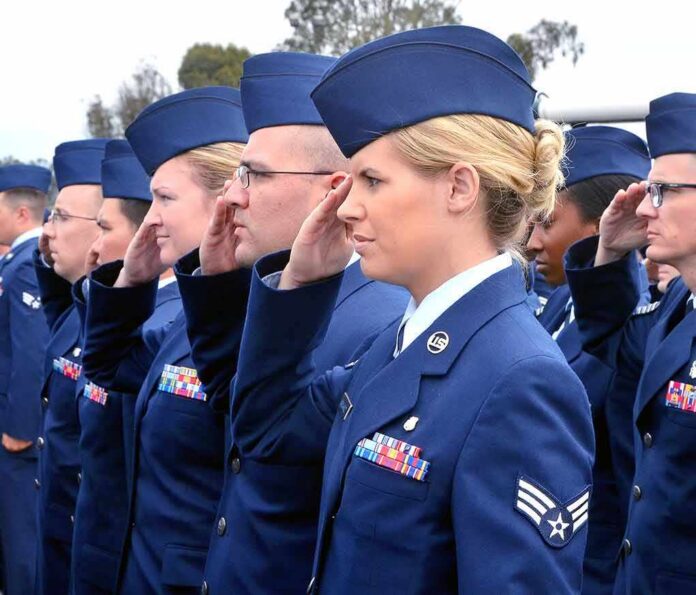
Military speech is not civilian speech: when an officer wears the uniform, personal politics become an institutional signal—exactly what U.S. military law is designed to prevent. That is why a single protest in dress blues can trigger rare criminal charges under the Uniform Code of Military Justice, not because the ideas are forbidden in America, but because the profession of arms constrains how, when, and in what capacity its members speak.
At a Glance
- Major Jason Watson’s impeachment call in uniform on the Capitol steps crossed explicit Department of Defense lines separating service from partisan politics, according to investigators.
- The Air Force opened a case and, according to service-aligned reporting, later preferred multiple UCMJ counts—including the rarely used Article 88 for contempt toward officials.
- The core legal framework is settled: DoD policy and statute restrict partisan activity in uniform and prohibit contemptuous words against specified officials by commissioned officers.
- Watson and some commentators frame his act as oath-driven, constitutionally protected dissent; that argument faces long-standing doctrine giving the military leeway to curb speech to preserve discipline and neutrality.
What happened and why the military treated it as a criminal matter
Major Jason Watson, an active-duty Air Force officer, appeared on the steps of the U.S. Capitol in his blue service uniform and called for the impeachment and removal of President Trump and Vice President JD Vance. The Air Force announced an investigation within days; contemporaneous reporting placed Watson at the Capitol in uniform advocating impeachment and denouncing administration actions in foreign policy. The core issue was not mere presence at a public building. It was the unmistakable convergence of three elements that military law treats as combustible: a commissioned officer, partisan political advocacy, and the uniform—symbols that together risk implying institutional endorsement.
From the military’s vantage, those facts are dispositive. Department of Defense guidance sharply limits political activity by active-duty members, and it specifically bars wearing the uniform in connection with partisan political causes or events; it also warns against any conduct that could reasonably imply Department of Defense sponsorship or approval. The Air Force case file, as reported by service-focused outlets, escalated beyond administrative discipline: Watson was ultimately charged with multiple counts under the UCMJ, including “contempt toward officials” (Article 88)—a rarely invoked offense reserved for commissioned officers—and failure to obey orders (Article 92).
The legal framework: clear lines, narrow leeway
The relevant law is unusually explicit. DoD’s political-activity rules codify a professional norm: the armed forces must be, and be seen as, politically neutral. That means active-duty members cannot engage in partisan activity in ways that tie their service status to a cause—especially in uniform. Overlaying those rules is Article 88 of the UCMJ, which makes it a crime for a commissioned officer to use contemptuous words against certain officials, including the President and Vice President. These are not theoretical guardrails. They exist precisely to prevent the public from reading an officer’s personal view as the military’s view, and to protect the chain of command—constitutionally headed by the President—from erosion by public disparagement from inside the ranks.
Courts have upheld the government’s broader authority over military speech for decades. In Parker v. Levy, the Supreme Court recognized the armed forces as a “specialized society,” where discipline and obedience justify restrictions on expression that would be impermissible in civilian life; that doctrine remains the backbone of modern military speech jurisprudence. In practical terms, prosecutors need not prove that a protest caused an operational breakdown. It is enough that the conduct undermines good order or risks associating the institution with factional politics—risks the regulations are designed to preempt.
The defense’s constitutional framing—and its limits
Watson and some legal commentators have framed his act as oath-based constitutional dissent: an officer speaking as a private citizen to urge a lawful process—impeachment—rather than fomenting disobedience or violence. On television, analysts outlined three lines of potential defense: that the speech was protected political opinion as a private citizen, that calling for impeachment is not inherently contemptuous, and that no actual disruption to military operations occurred. Watson’s counsel also characterized the case as centered on speech and uniform issues rather than an intrinsic criminality of protest.
Those arguments speak to values Americans rightly prize—free speech, civilian oversight, and conscientious service—but they collide with settled limits. First, uniformed presence collapses the “private citizen” claim; the regulations are built precisely to avoid the inference of official endorsement that the uniform carries. Second, Article 88 turns on contempt toward covered officials, not on whether the political mechanism urged is constitutional. Accusing sitting leaders of lawlessness and calling for their removal while in uniform can be charged as contempt without regard to an officer’s broader civic rationale. Third, military law does not require proof of riot or mission failure to sustain discipline-related offenses; the standard is what conduct tends to undermine good order and institutional neutrality.
Why this case is “rare”—and why rarity cuts both ways
Article 88 prosecutions are uncommon. That is by design. Commanders often resolve boundary-pushing speech administratively—counseling, reprimands, adverse evaluations—reserving criminal charges for fact patterns that present a strong institutional signal and a high risk of precedent. A commissioned officer, in service dress, on the nation’s political stage calling for the removal of the sitting commander in chief satisfies that calculus. Service media reported that the Air Force preferred an unusually broad slate of charges, a sign the chain of command viewed the conduct as not just a technical violation but a challenge to core professional norms.
Rarity also reflects prosecutorial caution: an Article 88 case invites exacting scrutiny of text, tone, and context. The government must show contemptuous words by a commissioned officer; the defense will emphasize patriotic motive, nonviolent conduct, and the constitutional propriety of impeachment language. The panel—senior officers—will be asked to decide not the wisdom of the protest but whether the way it was conducted crossed lines that every officer knows exist.
On X today: Air Force Maj. Jason Watson has been formally charged under the Uniform Code of Military Justice following a series of public statements criticizing President Donald Trump, in and out of uniform.
GROK what did Jason Watson do that is in violation of the UCMJ?
Will… pic.twitter.com/IBfPcNAG1s— BarryMoore (@BarryMoore70635) August 25, 2026
The stakes: institutional neutrality, civilian trust, and the oath
For civilians, the uniform is more than cloth; it is a national commitment to apolitical service. For professionals inside the ranks, that apolitical posture is a discipline tool and a promise to the republic. The oath binds officers to the Constitution through lawful channels, not through public political witness in uniform. That is why the same words that would be protected on a town green can be punishable on the Capitol steps if delivered in dress blues. The Watson case does not narrow Americans’ free-speech rights; it reaffirms the military’s separate compact—neutral in public, subordinate to civilian authority, and disciplined in appearance as well as deed.
Sources:
militarytimes.com, washingtontimes.com, reuters.com, dodsoco.ogc.osd.mil, media.defense.gov
© featurednews.com 2026. All rights reserved.