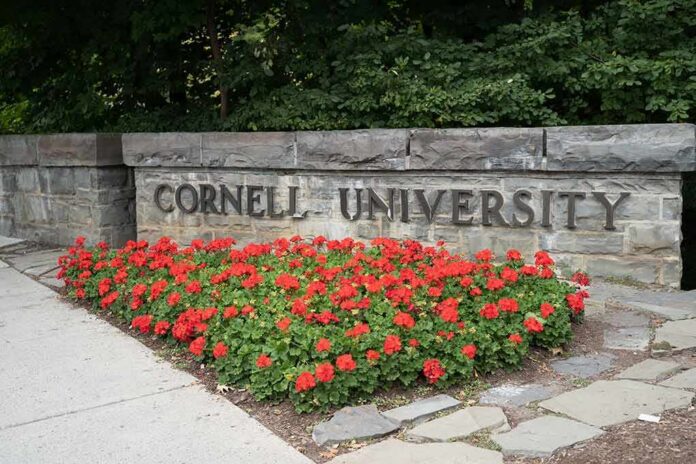
When a governor pulls a criminal case from a local prosecutor and hands it to the state’s top law-enforcement office, the story stops being just one allegation and becomes a test of how institutions handle sexual assault: evidence handling, parallel university processes, prosecutorial judgment, and public trust.
At a Glance
- Governor Kathy Hochul appointed Attorney General Letitia James as special prosecutor to reexamine the Cornell sexual assault allegations from October 2024, converting the matter into an active state-led criminal probe.
- The state cited newly surfaced information and alleged omissions in the original police-to-prosecutor handoff—specifically that the victim’s unequivocal account of rape was not transmitted—raising doubt about the original non-prosecution decision.
- A parallel civil suit lays out a coordinated-assault theory against seven fraternity members and points to digital communications as potential corroboration, creating investigatory leads beyond witness recollection.
- No criminal charges have been filed to date; the special prosecutor has authority to present to a grand jury if evidence supports it.
What Hochul’s Appointment Changes—and Why It Matters
Governor Hochul’s executive order did two things at once: it removed the case from the Tompkins County District Attorney and vested Attorney General Letitia James with charging authority; and it publicly reframed the matter from a closed, declined case to an ongoing criminal investigation with statewide visibility. In practical terms, a special prosecutor can consolidate fragmented records, compel production from institutions beyond local reach, and—critically—reset a credibility clock that often runs against older sex-crimes cases. James’s office has said this is now “an active criminal investigation,” with the mandate to prosecute if the record supports it.
The trigger for that reset was process, not politics. State officials said “newly released information” raised “serious questions” about the Cornell Police Department’s investigation and the DA’s decision not to prosecute. Chief among those questions: reporting that the victim’s statement—she was “100% confident” she had been raped—was not included in materials transmitted to prosecutors, and that the DA’s office did not independently interview her or seek full transcripts before declining the case. In sexual-assault prosecutions, the quality of the initial intake—what was asked, documented, preserved, and shared—often drives downstream outcomes. If that intake was incomplete, reopening is not just defensible; it is necessary.
How This Kind of Reopened Case Gets Built
Reopenings that move beyond rhetoric hinge on four evidentiary pillars. First, a complete investigative file—police reports, supplements, attachments, and any omitted statements—must be reconciled against what was actually provided to prosecutors. The gap between a narrative “summary” and full contemporaneous notes can be outcome-determinative. Second, the Title IX record—interviews, exhibits, and findings—must be obtained and tested for admissibility; campus processes run on different rules than criminal court, but they often contain leads law enforcement never exploited. Third, digital evidence—group chats, Snapchat messages, photos, and metadata—must be preserved at the platform level, then tied to devices and authors through forensic extraction; in group settings and alcohol- or drug-involved scenarios, digital trails can make or break questions of coordination and consent. Fourth, medical and toxicology evidence—ER records, SANE (sexual assault nurse examiner) documentation, and any chain-of-custody samples—must be reviewed by independent experts to evaluate claims of drugging and impairment with more than inference.
The civil complaint against seven fraternity members supplies a concrete theory of the case: coordinated conduct over a compressed time window in a single location, with contemporaneous digital chatter. That is investigable. According to reporting, the complaint includes a Snapchat group image and alleges invitations to join an assault; such material, if authenticated and contextualized through metadata and participant testimony, would be probative far beyond a “he said, she said” frame. The special prosecutor’s job is to turn these leads into admissible evidence—or discard them if they fail under forensic scrutiny.
The Parallel-Track Problem: Title IX vs. Criminal Law
Campus sexual-assault matters regularly split into parallel tracks with divergent standards and incentives. Title IX investigations are designed for educational compliance and administrative discipline; they are not built to meet the criminal standard of proof beyond a reasonable doubt. At the same time, confidentiality rules around those processes can leave criminal prosecutors without timely access to potentially useful witness statements or corroborating exhibits, and the public with a partial picture. The Cornell case, as described by state officials and reporting, exhibits the classic seam: a large, internal record existed, but key elements did not reach or were not pursued by the DA before declination. A special prosecutor with statewide authority can close that seam by compelling production and re-interviewing under oath.
Layered onto the track problem is New York’s legal architecture around intoxication and consent. Officials flagged the distinction between voluntary intoxication and drugging—an area of law that can complicate sexual-assault charging decisions when alcohol is involved, even if the moral line feels clear to lay observers. That legal backdrop does not decide the Cornell case, but it shapes how prosecutors evaluate likelihood of conviction at trial—especially two years on, when memories fade and digital content may have been deleted or overwritten.
Where the Disagreement Really Lies
There is no meaningful dispute that the state has now taken over and reopened the case. The friction sits elsewhere: in interpretations of the same night’s events and the adequacy of the original investigation. Jane Doe’s lawsuit alleges she was drugged and raped by seven men; several accused men have publicly denied wrongdoing, with some asserting that sexual contact, where it occurred, was consensual. Those positions are not evidentiary stalemates; they are claims that must be tested against records and forensics. The counter-narrative also emphasizes concerns about politicization, pointing to strong gubernatorial language and to Attorney General James’s prior public remarks in unrelated matters. Those critiques may shape public perception, but they do not substitute for record evidence in a criminal case.
The state’s rationale for intervention is concrete: potential omissions in police reporting, an incomplete prosecutorial review, and new materials surfacing through civil litigation and media that point to additional leads. In that frame, the decisive question is not who argued more forcefully in public, but whether the reconstructed, complete evidentiary file establishes crimes chargeable and provable to a jury.
President Donald Trump said Friday that he doesn’t believe the seven former Cornell University fraternity brothers accused in a lawsuit of raping a fellow student will get a “fair shake” now that state Attorney General Letitia James has been appointed special prosecutor by Gov.… pic.twitter.com/nsKmpxjHck
— NEWSMAX (@NEWSMAX) October 3, 2026
What “Happens Now” in Practice
Expect a methodical, staged process. First, subpoenas to Cornell University, Cornell Police, and the Tompkins County DA for full files, including any suppressed or omitted statements, Title IX exhibits, and internal memos explaining the original declination. Second, preservation and collection orders to Snapchat and other platforms, paired with device extractions from consenting witnesses or via warrant where appropriate. Third, a medical and toxicology review—both the initial records and any possibility of delayed testing that could still inform a drugging claim through metabolite patterns or clinical signs documented at the time. Fourth, structured interviews and, where necessary, compelled testimony of the seven named men and others flagged in chats; inconsistencies under oath often clarify murky timelines. Finally, a charging decision—potentially via grand jury presentation—based on whether the synthesized record can survive the rigor of cross-examination and jury instructions on consent, intoxication, and accomplice liability.
How to Read the Next Phase—Signals That Matter
Three signals will separate noise from progress. One, whether the special prosecutor can authenticate and contextualize the digital communications alleged in the civil complaint; corroborated coordination radically changes the evidentiary landscape. Two, whether the complete police and Title IX files align—or reveal critical omissions—relative to what the DA saw; if the original record was materially incomplete, grand jury review becomes more likely. Three, whether the medical/toxicology layer yields objective support for incapacitation or drugging; even without a perfect lab record, contemporaneous clinical observations can be powerful when aligned with timelines.
It is also possible that a reconstructed record still falls short of criminal proof; prosecutors have to try cases they can win on the law as it is, not as people wish it to be. But the state’s intervention ensures that whichever outcome prevails—charges or closure—will rest on a full, tested evidentiary file, not on a summary page and a missed interview. That is the minimum standard the public can demand in high-stakes allegations like these.
Sources:
reason.com, ag.ny.gov, cbsnews.com, bbc.com, aljazeera.com, cnn.com, abcnews.com
© featurednews.com 2026. All rights reserved.